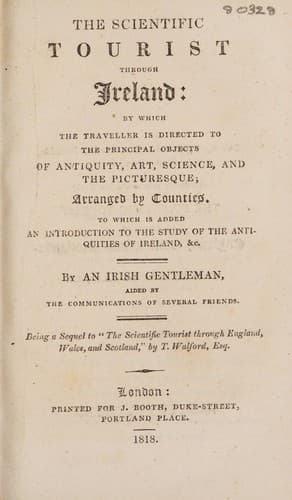
The Scientific Tourist through Ireland: in which the traveller is directed to the principal objects of antiquity, art, science & the picturesqueWalford, Thomas
History
The Scientific Tourist through Ireland: in which the traveller is directed to the principal objects of antiquity, art, science & the picturesque
Walford, Thomas
Ireland -- Description and travel
DUNDALK, 40 m. N. of Dublin, is one of the most ancient towns in
Ireland, claiming an early foundation from its bay and harbour on the
Irish Channel.--Being at the very extremity of what was called the
"English Pale," it often became exposed to hostilities, and presented
a mass of castles and towers, for the purposes of defence, of which
some remains may still be traced. See the remains of an ancient
monastery for Crouched Friars, since turned into an hospital: also
some ruins of a house of Gray Friars, of which a curious square tower
still remains; the prospect from its summit is rich and extensive.
Notice the Market-house. Inquire for Dundalk cambrics. See handsome
seat of Lord Roden, with curious antique portraits of Hen. VIII. and
Anne Bulleyn; spacious gardens; extensive well wooded demesne. See
Court-house, Gaol, Barracks, and Charter School. Town irregular, yet
neat; many of the houses displaying considerable taste and elegance.
About a mile westward, on the summit of a hill, seen for several
miles along the great north road, and commanding a most extensive
prospect of the Mourne and Carlingford mountains, are some remains of
a fine old Danish station and rath; a little below which, the tourist
will notice the ruins of an old Ch. or Chapel, enveloped in ivy, and
pointing out a Catholic cemetery of great sanctity. On the side of
the hill stands the Castle of Castletown, an ancient edifice with
towers and battlements, but partly repaired and habitable, forming the
offices to a more modern mansion close to it. This castle was taken
and sacked in the 14th century by Edward Bruce; and there are some
apparent vestiges of those times in earth-works on the side of the
hill, towards the river. The village itself is small, and contains
nothing else deserving of notice. Balrichan is a peninsula, about 2 m.
from Dundalk, containing several curious antiquities; some Druidical
remains; ruins of a Castle with subterraneous cave; the Giant's load,
a massy stone 12 feet long, 6 feet square, resting on three uprights;
Mount Albani, an earthen camp, with a tumulus: also Castle Rath, and
the tower of Ballug. At Bellurgan, see the park. Piedmont, a beautiful
residence of Lord Clermont; ruins of old Ch. and several Castles.
Carrickasticken has several raths, or sepulchral mounts. Fanghar, 2
m. N., has curious artificial mount, composed of stones and tarras,
60 feet high. At Killincool, on the Atherdee road, a fine old Castle,
with numerous vaults and secret passages. Lurgan Green, a smart
agreeable village; and a few miles N., see the Jonesborough mountains,
in all their native wildness. Near them is Ravensdale, romantically
seated on the rise of a mountain, with fine hanging-woods on every
side. On the summit of a rocky hill, 4 m. S., curious rath at Miltown;
and, close to the frontier of the English Pale,--in appearance and
situation very much resembling Bolsover Castle in England,--stand the
Public-domain text, read in full here on John Shaqi.
Reviews
Reviews
No reviews yet
Be the first to share your thoughts on this work.
Elsewhere in the archive
Join the Discussion
Join the discussion
Sign in to leave a comment or review.
Sign InorCreate an account