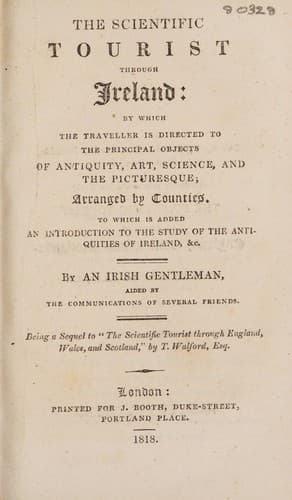
The Scientific Tourist through Ireland: in which the traveller is directed to the principal objects of antiquity, art, science & the picturesqueWalford, Thomas
History
The Scientific Tourist through Ireland: in which the traveller is directed to the principal objects of antiquity, art, science & the picturesque
Walford, Thomas
Ireland -- Description and travel
BURROS, 12 m. S.W. of Maryboro; a neat village, forming a good
station for the western district, having an excellent inn. Ruins of
Ballaghmore Castle, 3 m. W.; from whence may be visited Monaincha
Abbey in Tipperary. Grantstown Castle near Rathdowny. On the hill of
Kyle, a curious remnant of ancient judicature, the Brehon's Chair,
or Fairy Chair, as called in the vicinity. It is very near the top
of the hill, on its eastern side, and formed from the solid rock;
was the judgement-seat and public court of the Brehon, or chief of
the Fitzpatricks. See at Skirk, a very curious Pagan fane, situated
on a lofty hill, from whence the eye has a most extensive range. It
consists of an immense large earthen mound, the area surrounded by a
deep entrenchment, and in the centre, a pyramidal stone 6 feet high,
with the stumps of others which formed a temple. Towards the E. see a
cromlech; and on the north side, contiguous to the Parish Ch., a high
keep, or exploratory fort.
MARYBOROUGH, 40 m. S.W. of Dublin; the assize town. See ancient
Castle, demolished by Cromwell. 9 m. S.W. is Abbey Leix, the seat
of Lord de Vesci, a considerable domain covered with old timber,
and intersected by the river Nore, which, with the woods, forms its
principal charm, as the grounds are flat and unvaried. The statist
will contemplate with pleasure several neat villages in its immediate
vicinity, erected by the patronizing exertions of the noble landlord.
Aghaboe, near Abbey Leix, has remains of ancient Abbey and Cathedral,
of which little more than the chancel now exists; remnants of Gothic
architecture, in the windows and various niches, canopies and
concentric mouldings which yet adorn its mouldering walls; but much
injured by a late rector. The Abbey of Aghamacart lies to the S.
about 6 m. from Aghaboe, once very extensive, and now in ruins. At a
distance nothing appears but the gloomy belfry; but the visitor soon
arrives at an arch of good workmanship which opens into the body of
the ruins, or rather into the remains of the chapel. There is, indeed,
little to attract attention, were it not for a legendary tale, of a
monk whose affection for a lovely nun was met with such reciprocity
on the part of the lady, that gossip scandal would soon have spread
her thousand wings. To expiate his crime and escape reproach, the
monk flung himself from the battlements of a tower and perished; but
the fate of the unhappy fair is wrapped up in oblivion. Aghamacart
Castle, now forming a total yet picturesque ruin, is not of earlier
date than the reign of Elizabeth. Ballinakill, 9 m. S., ruins of
Castle, demolished by Cromwell. About 15 m. S.E., on a small point
of land watered by the Barrow, stand the very picturesque ruins of
Cloghgrennan Castle, deeply embosomed in foliage and entwined with
ivy. About 4 m. E. is Dunamase, a hill fort, which, though almost
in total ruins, affords to the antiquary and to the man of taste a
Public-domain text, read in full here on John Shaqi.
Reviews
Reviews
No reviews yet
Be the first to share your thoughts on this work.
Elsewhere in the archive
Join the Discussion
Join the discussion
Sign in to leave a comment or review.
Sign InorCreate an account