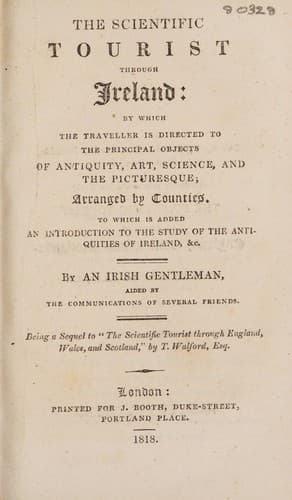
The Scientific Tourist through Ireland: in which the traveller is directed to the principal objects of antiquity, art, science & the picturesqueWalford, Thomas
History
The Scientific Tourist through Ireland: in which the traveller is directed to the principal objects of antiquity, art, science & the picturesque
Walford, Thomas
Ireland -- Description and travel
very good specimen of the military manners of earlier times. Though
standing on an insulated rock, its name signifies the "Fort of the
Plain." This rock is inaccessible on all sides except the east,
which, in its perfect state, was defended by the Barbican, of which
a considerable part remains. Here began the principal defences, with
ditches on each side, until stopped by rocks, where walls seem to have
been erected, with two towers for the protection of the Barbican, from
whence the visitor enters the Ballium or Bailey, the gate of which is
7 feet wide, with walls six feet in thickness, and the remains of a
parapet crenelled and embattled. This leads to the upper Ballium, the
gate of which is in a tower, from whence fragments of walls extend
on both sides; here too was the keep, with a sally-port and prison.
This fortress belonged to Dermod McMurrough, King of Leinster; but
the present remains are rather of later date; perhaps the work of the
Pembroke family in the 13th century. It is now repairing by Sir H.
Parnell, with judicious attention to its gothic grandeur. Doonaun,
a village about 16 m. S.E., has extensive coalpits, which claim the
notice of the mineralogist by rocks of whinstone resting on a stratum
or column of basaltes, 40 feet below the surface; below which are
strata of slate and iron ore. Great Heath, or Rathean Common, 2 m. N.
of Maryborough, is memorable for a battle in the 3d century between
the people of Munster and Leinster; and the bones of the slain are
often dug up at the present day. Killone Hill is conical, with curious
cavern and subterranean lake, highly worth the tourist's notice. Near
it a fine quarry of calcareous stone equal to Portland. The Maragah,
or Margy Mountains in the S.E. present a fine field for the geologist.
About 1-1/2 m. N. of Dunamase, the tourist will descry a small
fortress, called Shean Castle, standing on the summit of one of the
high, steep, conical hills, so frequent in this part of the county.
It is still habitable, though its surrounding defences have been
long in ruins, demolished in the Civil wars. Stradbally, 6 m. S.E.,
neat village, handsome Ch., good Market-house, and Charter School.
See Brockly Park, the magnificent seat of Earl Roden; and Stradbally
Hall, that of Mr. Crosbie: about 4 m. S. is Dun-cliun-poic, or Dun of
Clipoke, an insulated rock with curious caves; near it is a tombstone
with Druidic inscription. About 6 m. S. from Stradbally, stands the
Castle of Timahoe, an edifice not older than the reign of Elizabeth,
but now completely in ruins, having stood a siege in the civil wars,
at which time it was dilapidated. Its area is now filled with cabins
of the peasantry: there is nothing very interesting to the tourist;
but close to it there is one of the ancient round towers, now fast
mouldering away. The entrance is at a height of fourteen feet from
the ground, and is ornamented with a chevron or zigzag moulding, a
Public-domain text, read in full here on John Shaqi.
Reviews
Reviews
No reviews yet
Be the first to share your thoughts on this work.
Elsewhere in the archive
Join the Discussion
Join the discussion
Sign in to leave a comment or review.
Sign InorCreate an account