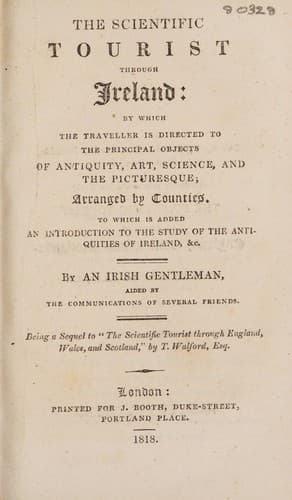
The Scientific Tourist through Ireland: in which the traveller is directed to the principal objects of antiquity, art, science & the picturesqueWalford, Thomas
History
The Scientific Tourist through Ireland: in which the traveller is directed to the principal objects of antiquity, art, science & the picturesque
Walford, Thomas
Ireland -- Description and travel
ABBEY BOYLE, or BOYLE, 20 m. N. of Roscommon, pleasantly seated on the
river Boyle. See two stone Bridges, on one of which is a pedestrian
statue of William III.; fine Ch. and barrack. In Lord Kingston's
demesne the attention of the antiquary will be turned to the ruins
of the ancient Abbey, which stand within it at the back of the town,
presenting a most elegant specimen of the architecture of the 13th
century, when it was founded for Cistertian monks in honour of the
Virgin. It is now a mere picturesque mass of ruin, filled with lofty
trees and much thorny underwood. The approach from the bridge is
very grand; especially the effect of the tower, covered with thick
foliage, and springing from great arches which were 45 feet in height
before the ravages of time had spread the floor with the relics of
the mouldering walls. The interior has once been very fine; solid
walls fill up the spaces between the pillars, supposed to have been
erected in the reign of Elizabeth, when this dissolved monastery was
turned into a fortified post, for which it was certainly well fitted,
and actually stood a siege from the Earl of Tyrone in 1595. The east
window, when in its glory, must have been extremely beautiful. Near
to the Abbey are some vestiges of one of the round towers; and every
thing around it would tend to produce a most impressive scene, were
it not that the cloisters have been long occupied as a barrack: yet
the silence and gloom of the interior, with the solemn arcades, and
the emblems of mortality that lay scattered over its surface, will
not fail to gratify the contemplative visitor. Cambo Castle is about
2 m. distant. About 7 m. from Boyle, and upon the edge of a very
extensive bog, are the ruins of the Abbey of Clonshanville, now almost
a total ruin. Of the cloisters no remnant exists; but the tower, 60
feet high, forms a pleasing object, with the few Gothic fragments at
its base. Croghan is immortalized as the residence of Cathmor, the
friend of strangers: here is an ancient Rath, also a sacred Cave of
the Druids, and near to it Relig-na-Riagh, or the resting-place of the
Kings of Connaught, an immense cemetery in a circle 200 feet diameter.
Visit French Park. See Kingston Hall, an elegant mansion of Lord
Lorton. Lough Arrow, 3 m. N. of Boyle, is beautifully studded with
wooded islands: also Lough Gara to the W. Lough Glinn is also in this
vicinity; on its banks stands a noble mansion of Viscount Dillon, with
some extensive grounds, of modern erection and improvement; and on the
opposite shore the tourist may visit two ruinous towers, which are
all that remain of a once very extensive antique fortress, a feudal
residence of the old barons of Ophaley. One of these towers has long
been used as a temporary prison.
ATHLONE, 12 m. S.E. of Roscommon, is principally in Westmeath, where
it will be described.
Public-domain text, read in full here on John Shaqi.
Reviews
Reviews
No reviews yet
Be the first to share your thoughts on this work.
Elsewhere in the archive
Join the Discussion
Join the discussion
Sign in to leave a comment or review.
Sign InorCreate an account