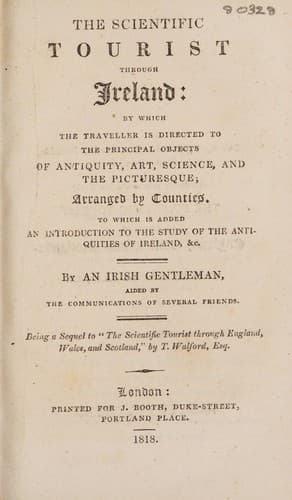
The Scientific Tourist through Ireland: in which the traveller is directed to the principal objects of antiquity, art, science & the picturesqueWalford, Thomas
History
The Scientific Tourist through Ireland: in which the traveller is directed to the principal objects of antiquity, art, science & the picturesque
Walford, Thomas
Ireland -- Description and travel
circumstance which opens a wide field of conjecture as to date and
origin.
MOUNTMELLICK, 6 m. N.E. of Maryborough, is a pretty little village,
perfectly in unison with its inhabitants who are Quakers. Near it see
Ballyfinn, a modern house of the Rt. Hon. W. W. Pole: fine lake; noble
lawns; elegant apartments; well wooded demesne; and most extensive
prospects. See ruins of Cloneslee and Cuffe Castles; also freestone
quarry at Rosenallis.
MOUNTRATH, 7 m. W. of Maryborough; pleasant little village on
the Nore, with good river scenery. From hence the picturesque or
geological tourist may visit the mountains of Slieve Boomy, or Bloom,
in the N.W.
PORTARLINGTON, 9 m. N.E., stands partly in King's County, (where it
has been noticed,) large, populous, and genteel. At Ballybrittas,
ruins of Castle, demolished by Cromwell; with numerous country
seats in vicinity; particularly Dawson's Grove, residence of Lord
Portarlington. Near this town, see Lea Castle, famous in the wars
of the 13th century, and standing on a rising ground. This edifice
manifests the strength that was given to these dens; for its walls are
8 feet thick in some places, in others 10. It was 60 feet long, 46
feet broad; its arches all circular except one pointed one. The river
Barrow secured one side, and filled the ditches of the other; so that
it was only approachable by a narrow causeway 100 feet in length, a
good defence before the introduction of artillery. See ruins of Morit
Castle near Emo, in a wild valley, intersected by a rivulet.
MINERALS.
Coal and iron ore in Slewmargy; Chalybeate Spa, near Portarlington.
BOTANY.
Yet unexplored.
ROSCOMMON.
A small inland county, not remarkable for grandeur of scenery,
consisting principally of rich, extensive pasturage, intermixed with
considerable masses of bog. There are some pretty views on the banks
of the Shannon, which forms its eastern boundary. For the mineralogist
there is little to interest, as its basis throughout is almost one
continued sheet of limestone. Bounded E. by the Shannon; S. by Galway;
W. by Mayo; N. by Sligo; N.E. by Leitrim.
Public-domain text, read in full here on John Shaqi.
Reviews
Reviews
No reviews yet
Be the first to share your thoughts on this work.
Elsewhere in the archive
Join the Discussion
Join the discussion
Sign in to leave a comment or review.
Sign InorCreate an account