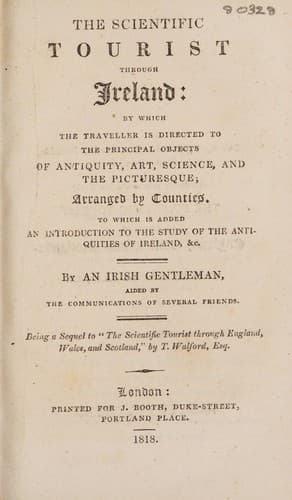
The Scientific Tourist through Ireland: in which the traveller is directed to the principal objects of antiquity, art, science & the picturesqueWalford, Thomas
History
The Scientific Tourist through Ireland: in which the traveller is directed to the principal objects of antiquity, art, science & the picturesque
Walford, Thomas
Ireland -- Description and travel
BALLINAFADD, 15 m. S.E. of Sligo, is a small village, but will afford
shelter to the tourist who wishes to examine its vicinity. See the
ruins of ancient Castle, picturesque and pleasing, the feudal den
of the clan MacDonough, with thick walls, circular tower, and most
extensive prospects over the Curlew mountains, along Lough Arrow; and
along a wild but romantic valley to the S. Ballymote, 5 m. N.W., has a
Castle which presents a good specimen of ancient military architecture
at the commencement of the 14th century, when erected by Richard de
Burgo, the red Earl of Ulster, a man of high power and possessions.
The ruins are still very extensive, and seem almost to bid defiance to
time. Six round towers, one of which is 53 feet in height, flanked the
walls that were 9 feet in thickness, with a gallery or covered way of
communication all round. At the end of the town are some remains of
the ancient Ch., with some finely pointed Gothic arches, and curious
east window. Franciscan Friary. Somewhere in this vicinity is Corren,
with curious caves called the Giant's House, with an approach cut in
the rock, steep and difficult. Lough Arrow, already noticed under
Roscommon, presents much romantic scenery. On its banks, in a wild
open district, stood a Convent of Dominican nuns (1427) in honour
of the Virgin. At present little remains except the Ch., called
Ballindown Abbey, in sufficient preservation to show its ancient form,
though unroofed. It consists principally of two Chapels united by a
belfry, with this curious architectural whim, that the east and west
windows only are Gothic, but all the others elliptical.
ENNISCROWEN, or ENISCRONE, about 28 m. W. of Sligo, may be visited
by those who venture to explore the wild recesses of the barony of
Tyreragh. Castle Connor, near to it, has curious caves, lined and
roofed with great stones, on a hill, as yet scarcely noticed by the
antiquary. Close to the sea stand the remains of the ancient Castle
of Roslee, sombre and solitary. Little more now exists than one
lofty tower, in the thickness of whose walls is a curious staircase
leading to the gloomy apartments within. The Castle was originally
of considerable extent, and near it runs a rivulet, traditionally
said to have once been fitted with a weir for the purpose of catching
salmon; the fish, by an ingenious contrivance, ringing a bell as soon
as caught, and thereby giving notice to the cook of their capture. At
Screen, 15 m. N.E., see Danish-Stone Rath on a hill.
Public-domain text, read in full here on John Shaqi.
Reviews
Reviews
No reviews yet
Be the first to share your thoughts on this work.
Elsewhere in the archive
Join the Discussion
Join the discussion
Sign in to leave a comment or review.
Sign InorCreate an account