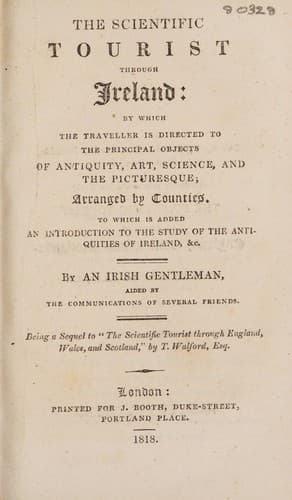
The Scientific Tourist through Ireland: in which the traveller is directed to the principal objects of antiquity, art, science & the picturesqueWalford, Thomas
History
The Scientific Tourist through Ireland: in which the traveller is directed to the principal objects of antiquity, art, science & the picturesque
Walford, Thomas
Ireland -- Description and travel
SLIGO, 104 m. N.W. of Dublin, stands upon a river, by which the waters
of Lough Gilly are discharged into a large bay, and which admits
vessels of 200 tons up to its quay. See Court-House, Gaol, Barrack,
Infirmary, and Charter School; Custom House and quays; much trade;
good accommodations. Close to the town, and pleasantly seated on the
river Gilly, near its confluence with the sea, stand the ruins of
the ancient Abbey, of early foundation, but burnt down in the 15th
century, and immediately afterwards rebuilt in a very superior style
of sculpture and architecture. It has two large chapels divided by a
square belfry, the tower of which is entire except the battlements,
and resting on a lofty Gothic arch. The other arches of the Gothic
colonnades are lofty, and enriched with foliage and angels. The Ch.
is completely uncovered; three sides of the cloisters have an arched
roof in pretty good preservation: their arches are semicircular; but
a profusion of Gothic ornament exists in other parts of the edifice.
The front and sides of the altar are ornamented with Gothic arches,
foliage, and tracery; and there still remain pedestals for statues,
whose sanctity could not work miracles against Time. The tourist must
not neglect to notice the eastern window, which is very beautiful.
Around the nave is a stone gallery; and at a height of several
feet from the ground may still be seen the tomb of O'Connor, lord
of Sligo, his figure and that of his lady kneeling on each side of
an altar. Taking a ramble about 4 m. S. from the town, the tourist
will see, at the foot of a small hill, the neat village and Abbey
of Ballysadere, erected about the 12th century for Augustine monks.
At present nothing can be traced but the arches of the belfry and a
small part of the tower, built of black stone: not far distant are
the picturesque remains of an ancient Chapel, with windows of cut
stone, and some curious carved heads on the doorway. Visit Nymphsfield
near Ballysadere, where there is a waterfall worth sketching. The
Giant's Grave, or Lugne Clogh consists of several stones resembling
Stonehenge. Innismurry is an island of the north coast, with curious
subterraneous cells: also interesting to the sportsman. Lough Gilly
abounding with romantic scenery; about 5 m. long, and 2 broad. Its
greatest charm is Hazelwood, the beautiful seat of Mr. Wynn, at the
end of a wooded peninsula which runs out into the water, and is seen
to most advantage from the lake. On the opposite side of the lake,
contrasting finely with the lawns and artificial arrangements of
Hazelwood, is seen a range of rude mountains, partially planted and
cultivated; beyond which is another range in fine retiring distance.
In the island of Innismore are ruins of an old Ch. of the Culdees,
covered with ivy, and marked by numerous superstitions. Knocknaree
is a mountain of considerable altitude and extensive base, in a
wide field of desolation.
Public-domain text, read in full here on John Shaqi.
Reviews
Reviews
No reviews yet
Be the first to share your thoughts on this work.
Elsewhere in the archive
Join the Discussion
Join the discussion
Sign in to leave a comment or review.
Sign InorCreate an account