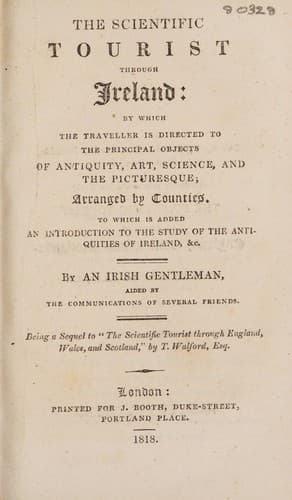
The Scientific Tourist through Ireland: in which the traveller is directed to the principal objects of antiquity, art, science & the picturesqueWalford, Thomas
History
The Scientific Tourist through Ireland: in which the traveller is directed to the principal objects of antiquity, art, science & the picturesque
Walford, Thomas
Ireland -- Description and travel
Strancally, and Dromana; but all must yield to Lismore. The tourist
will find a good inn and a good salmon fishery. Aglish, 4 m. S.E., is
near Dromana, already noticed under Dungarvon. See ruins of ancient
Castle; also ruins of venerable Abbey, 1 m. Cappoquin, 2 m. across
the Blackwater, has a wooden bridge and ruins of ancient Castle,
with a most enchanting and extensive prospect. Curwen describes it
as a small neat town, with several handsome seats ornamented with
timber and very picturesque scenery in its vicinity. Sir R. C. Hoare
recommends to notice Dromana House, rising perpendicularly from a rock
completely covered with trees; the character of that bend of the river
being richness, with cultivated lands decked with trees, and distant
mountains: also Turin, a modern house on an old Castle, seat of Mr.
Kane, a finely wooded dingle in front backed with lofty mountains;
ruined Ch. on the left; flat islands planted with willows; quarries
of limestone, one fine mass of which bounds the river on the left.
Modeligo, 7 m. E., has ancient Castles of the Magraths. Oon a mort
is a small cave, similar to that of Con-a-glour. Strancally is 6 m.
S. towards the mouth of the river, with ancient Castle and curious
cave, respecting which there are some horrid legends: and near it the
handsome seat of Headborough, with venerable ruins of Molana Abbey.
Tallagh, 6 m. S.W., is a poor decayed village, with Lessfinny Castle
near to it.
WATERFORD, 75 m. S. of Dublin, is episcopal and collegiate.--From
Carrick-on-Suir to this place the road passes through a district which
exhibits a great variety of picturesque views along the banks of
that river. From the nature of the situation, the city itself is not
seen until the traveller is within a short distance of it, standing
apparently in the bottom of a basin, with the Suir, about a mile
broad and crowded with shipping, flowing close to its side. See the
noble quay, about 1 m. in length, with a wooden bridge which has a
drawbridge in the centre, adding much to the beauty and convenience
of the city. Elegant modern Cathedral. Handsome episcopal Palace. 3
Parish Ch. 4 Catholic Chapels. Court-House, erected on Black-friars
Monastery. Tholsel. Gaol. Custom-House. Exchange. Coffee-Rooms.
Assembly Rooms, and Theatre. Remains of Franciscan Friary. The
earliest remnant of antiquity to be seen here, is a circular tower
situated in the eastern angle of the city walls, said to be the work
of a Danish chieftain in 1003, and (after him) called Reginald's
Tower. The bridge is constructed of American oak. It is 832 feet
long, 42 broad, has two sets of piers, each of seven pieces, besides
cut-waters. The longest pile driven was 70 feet; the depth at low
water is 37 feet, and the rise of the highest tides is 17 feet.
Here is an existing Catholic Monastery. See the Woollen and Glass
Manufactories; also Clonegan Tower, 72 feet high, erected by the late
Public-domain text, read in full here on John Shaqi.
Reviews
Reviews
No reviews yet
Be the first to share your thoughts on this work.
Elsewhere in the archive
Join the Discussion
Join the discussion
Sign in to leave a comment or review.
Sign InorCreate an account