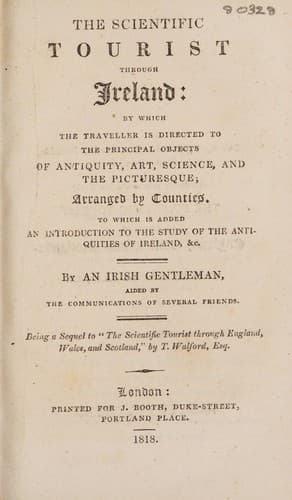
The Scientific Tourist through Ireland: in which the traveller is directed to the principal objects of antiquity, art, science & the picturesqueWalford, Thomas
History
The Scientific Tourist through Ireland: in which the traveller is directed to the principal objects of antiquity, art, science & the picturesque
Walford, Thomas
Ireland -- Description and travel
Marquis of Waterford to the memory of his son. Carrickbeg, 12 m. W.,
opposite to Carrick-on-Suir, has ruins of Franciscan Friary, with a
leaning steeple. Whilst in this vicinity the tourist will be gratified
by a ride over the large demesne of Curraghmore, which in many parts
commands the most extensive prospects of the surrounding country. Mr.
Wakefield notices that from the tower the eye can trace the Suir the
whole way to Waterford, while the ocean, stretched out along the coast
on the S., forms in the remote part of the picture a very fine object.
The house is seen to most advantage in front, as it is backed by wood
which exhibits very grand scenery. There are some good paintings. The
demesne is stated by Mr. W. to contain 2800 acres, of which nearly
one half is covered with wood. The whole of this extended property
is surrounded by walls; and it excels in mountain scenery and woody
wildness. Kilmanahan Castle, a mansion recently erected on the site of
an ancient Castle, and preserving the old style of architecture, which
gives it a very venerable appearance, rising from the summit of a rock
at a bending of the Suir, which here divides the two counties. This
position gives it the advantage of a very extensive prospect; and Mr.
Wakefield declares that grandeur, united with elegance, renders this
one of the completest residences that he had ever seen. Here too the
Suir runs with great rapidity, and is seen rolling his waters beneath
well wooded banks, with the Galtees mountains in the distance. Visit
Kilmeaden Castle, Ch. and Spa. Passage is the place of embarkation
for the Milford Haven packets, with ruins of Ch. and most extensive
prospect from Faithleag-hill. Good inns. Tramore, 6 m. S., is an
excellent bathing-place; delightful village, with neat Assembly Room
and all the usual accommodations.
MINERALS.
Granite is the basis; and here has been found a stratum of clay equal
to that of Stourbridge for glass-house pots.
BOTANY.
_Allium carinatum_, Purple-flowered Mountain Garlic:--on pasture lands.
_Althæa officinalis_, Marsh Mallow:--in the isles of Icane.
_Asplenium Adiantum nigrum_, Common Black Maiden Hair:--on mountains.
_Carex dioica_, Small Carex:--in bogs.
_Carum Carui_, Caraway:--in meadows and pastures:--near Woodhouse in
the parish of Stradbally.
_Canvallaria majalis_, Lily Convally or May Lily:--in a wood near the
river Collygan.
_Crithmum maritimum_, Samphire:--on sea cliffs.
_Cucubalus otites_, Spanish Catchfly:--in a grove near Lismore, near
the Blackwater river.
_Daphne Laureola_, Spurge Laurel:--in a wood near Mogehy in the parish
of Whitchurch.
_Drosera longifolia_, Long-leaved Sundew:--on a bog near Ballycaroge.
_Eryngium campestre_, Common Eryngo:--in the sand near Youghal harbour.
_Gladiolus communis_, (Linn.) Sword Grass or Corn Flag:--at the upper
end of the Conegary, at Dungarvon.
_Imperatoria Ostruthium_, Masterwort:--on Slatwood Hill near Lismore,
and Tallow.
Public-domain text, read in full here on John Shaqi.
Reviews
Reviews
No reviews yet
Be the first to share your thoughts on this work.
Elsewhere in the archive
Join the Discussion
Join the discussion
Sign in to leave a comment or review.
Sign InorCreate an account