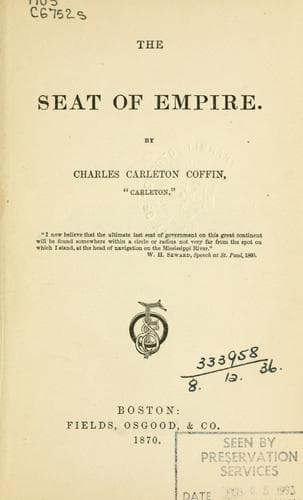
Minnesota -- Description and travel; Northwest, Canadian; Northwestern States; Red River of the North
I have thought of this section of country as being almost up to the
arctic circle, and can only disabuse my mind by comparing it with
other localities in the same latitude. St. Paul is in the latitude of
Bordeaux, in the grape-growing district of Southern France. Here at
Fort Abercrombie we are at least one hundred and fifty miles farther
south than the world's gayest capital, Paris.
It is not likely that Northern Minnesota will ever become a
wine-producing country, though wild grapes are found along the streams,
and the people of St. Paul and Minneapolis will show us thrifty vines
in their gardens, laden with heavy clusters.
Minnesota is a wheat-growing region, climate and soil are alike
favorable to its production.
On the east bank of the Red River we see a field owned by Mr. McAuley,
who keeps a store and sells boots, pipes, tobacco, powder, shot, and
all kinds of supplies needed by hunters and frontiersmen. He sowed his
wheat this year (1869) on the 5th of May, and it is now, on the 19th of
July, heading out. "I had forty-five bushels to the acre last year," he
says, "and the present crop will be equally good."
[Illustration: RED RIVER VALLEY.]
This Red River Valley throughout its length and breadth is very
fertile. Here are twenty thousand square miles of land,--an area as
large as Vermont and New Hampshire combined,--unsurpassed for richness.
The construction of the Northern Pacific Railroad and the St. Paul and
Pacific, both of which are to reach this valley within a few months,
will make these lands virtually as near market as the farms of Central
or Western Illinois. From the Red River to Duluth the distance is 210
miles in a direct line. It is 187 miles from Chicago to Springfield,
Illinois; so that when the Northern Pacific Railroad is constructed to
this point, Mr. McAuley will be just as near Boston or New York as the
farmers who live in the vicinity of the capital of Illinois; for grain
can be taken from Duluth to Buffalo, Oswego, or Ogdensburg as cheaply
as from Chicago. The richness of the lands, the supply of timber on the
Red River and all its branches, with the opening of the two lines of
railway, will give a rapid settlement to this paradise of the Northwest.
Professor Hind, of Toronto, who was sent out by the Canadian government
to explore the British Possessions northwest of Lake Superior, in his
report says: "Of the valley of the Red River I find it impossible to
speak in any other terms than those which may express astonishment and
admiration. I entirely concur in the brief but expressive description
given me by an English settler on the Assinniboine, that the valley
of the Red River, including a large portion belonging to its great
affluents, is a paradise of fertility."
Public-domain text, read in full here on John Shaqi.
Reviews
Reviews
No reviews yet
Be the first to share your thoughts on this work.
Join the Discussion
Join the discussion
Sign in to leave a comment or review.
Sign InorCreate an account