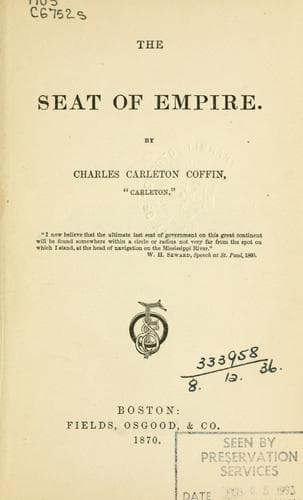
Minnesota -- Description and travel; Northwest, Canadian; Northwestern States; Red River of the North
"It remains for me to call the attention of the English government
to the advantages there would be in establishing agricultural
districts in the vast plains of Rupert's Land, and particularly in
the Saskatchawan, in the neighborhood of Fort Carlton. This district
is much better adapted to the culture of staple crops than one would
have been inclined to believe from this high latitude. In effect, the
few attempts at the culture of cereals already made in the vicinity of
the Hudson Bay Company's posts demonstrate by their success how easy
it would be to obtain products sufficiently large to remunerate the
efforts of the agriculturist. Then, in order to put the land under
cultivation, it would be necessary only to till the better portions
of the soil. The prairies offer natural pasturage as favorable for
the maintenance of numerous herds as if they had been artificially
created. The construction of houses for habitation and for pioneer
development would involve but little expense, because in many parts
of the country, independent of wood, one would find fitting stones
for building purposes, and it is easy to find clay for bricks.... The
vetches found here are as fitting for nourishment of cattle as the
clover of European pasturage. The abundance of buffaloes, and the
facility with which herds of horses and oxen increase, demonstrate that
it would be enough to shelter animals in winter, and to feed them in
the shelters with hay.... In the gardens of the Hudson Bay Company's
posts, beans, peas, and French beans have been successfully cultivated;
also cabbages, turnips, carrots, rhubarb, and currants" (p. 250).
The winters of the Northwest are wholly unlike those of the Eastern and
Middle States. The meteorologist of Palliser's Expedition says: "Along
the eastern base of the Rocky Mountains there is a narrow strip of
country in which there is never more than a few inches of snow on the
ground. About forty miles to the eastward, however, the fall begins to
be much greater, but during the winter rarely exceeds two feet. On the
prairies the snow evaporates rapidly, and, except in hollows where it
is drifted, never accumulates; but in the woods it is protected, and in
spring is often from three to four feet deep" (p. 268).
Captain Palliser and party travelled from post to post during the
winter without difficulty. In February, 1859, he travelled from
Edmonton to Lake St. Ann's. On two nights the mercury was frozen in the
bulb,--as it is not unfrequently at Franconia, New Hampshire. Exclusive
of those two cold nights, the mean of the temperature was seventeen. He
says: "This was a trip made during the coldest weather experienced in
the country. If proper precautions are taken, there is nothing merely
in extreme cold to stop travelling in the wooded country, but the
danger of freezing from exposure upon the open plains is so great that
they cannot be ventured on with safety during any part of the winter"
(p. 268).
Public-domain text, read in full here on John Shaqi.
Reviews
Reviews
No reviews yet
Be the first to share your thoughts on this work.
Join the Discussion
Join the discussion
Sign in to leave a comment or review.
Sign InorCreate an account