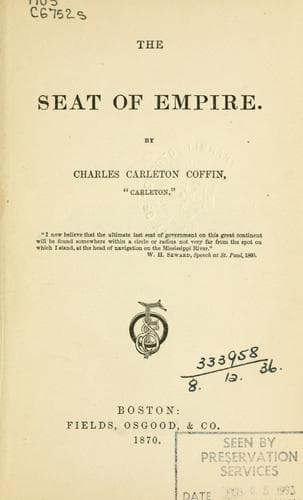
Minnesota -- Description and travel; Northwest, Canadian; Northwestern States; Red River of the North
I think of the country which those who are going west will see, and of
the region beyond,--the valley of the Yellowstone, the Missouri, the
slopes of the Rocky Mountains, and the hills of Montana,--territory to
be included in the future Empire of the Northwest. I have written the
word, but it bears no political meaning in these notes. It has the same
signification as when applied to the State of New York. The Empire of
the Northwest will be the territory lying north of the central ridge
of the continent. Milwaukie may be taken as a starting-point for a
survey of this imperial domain. That city is near the 43d parallel;
following it westward, we see that it passes over the mountain-range on
whose northern slopes the southern affluents of the Yellowstone take
their rise. All the fertile valleys of the Columbia and its tributaries
lie north of this parallel; all the streams of the Upper Missouri
country, and the magnificent water-system of Puget Sound, and the
intricate bays and inlets of British Columbia, reaching on to Alaska,
having their only counterpart in the fiords of Norway, are north of
that degree of latitude. I have already taken a view of the region
now comprised in the British dominions east of the Rocky Mountains;
but equally interesting will be a review of the territories of the
Republic,--Dakota, Montana, Idaho, Oregon, and Washington, also British
Columbia and Vancouver.
Dakota contains a little more than a hundred and fifty thousand square
miles,--nearly enough territory to make four States as large as Ohio.
"The climate and soil of Dakota," says the Commissioner of Public
Lands, General Wilson, in his Report for 1869, "are exceedingly
favorable to the growth of wheat, corn, and other cereals, while all
the fruits raised in the Northern States are here produced in the
greatest perfection.... The wheat crop varied from twenty to forty
bushels to the acre. Oats have produced from fifty to seventy bushels
to the acre, and are of excellent quality" (p. 144).
Settlements are rapidly extending up the Missouri, and another year
will behold this northern section teeming with emigrants. The northern
section of the territory is bare of wood, but the southern portion is
well supplied with timber in the Black Hills.
Two thousand square miles of the region of the Black Hills, says
Professor Hayden, geologist to the United States Exploring Expedition
under General Reynolds, is covered with excellent pine timber. That
is an area half as large as the State of Connecticut, ample for the
southern section; while the settlers of the northern portion will be
within easy distance by rail of the timbered lands of Minnesota.
Public-domain text, read in full here on John Shaqi.
Reviews
Reviews
No reviews yet
Be the first to share your thoughts on this work.
Join the Discussion
Join the discussion
Sign in to leave a comment or review.
Sign InorCreate an account