Minnesota -- Description and travel; Northwest, Canadian; Northwestern States; Red River of the North
With the map of the continent before me, I stick a pin into
Minneapolis, and stretch a string to Halifax, then, sweeping southward,
find that it cuts through southern Florida, and central Mexico. It
reaches almost to San Diego, the extreme southwestern boundary of the
United States,--reaches to Donner Pass on the summit of the Sierra
Nevadas, within a hundred miles of Sacramento. Stretching it due west,
it reaches to Salem, Oregon. Carrying it northwest, I find that it
reaches to the Rocky Mountain House on Peace River,--to that region
whose beauty charmed Mackenzie and Father De Smet. The Peace River
flows through the Rocky Mountains, and at its head-waters we find the
lowest pass of the continent. The time may come when we of the East
will whirl through it upon the express-train bound for Sitka! It is two
hundred miles from the Rocky Mountain House to that port of southern
Alaska.
The city of Mexico is nearer Minneapolis by nearly a hundred miles
than Sitka. Trinity Bay on the eastern coast of Newfoundland, Puerto
Principe on the island of Cuba, the Bay of Honduras in Central America,
and Sitka, are equidistant from Minneapolis and St. Paul.
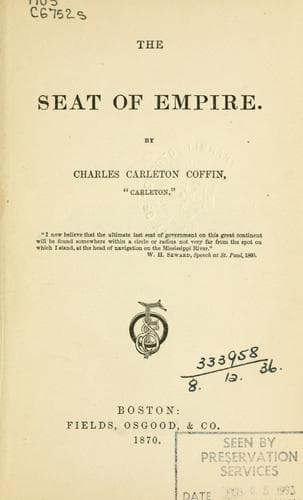
When Mr. Seward, in 1860, addressed the people of St. Paul from the
steps of the Capitol, it was the seer, and not the politician, who
said:--
"_I now believe that the ultimate last seat of government on this
great continent will be found somewhere within a circle or radius not
far from the spot on which I stand, at the head of navigation on the
Mississippi River!_"
CHAPTER V.
THE FRONTIER.
Bottineau is our guide. Take a look at him as he sits by the camp-fire
cleaning his rifle. He is tall and well formed, with features which
show both his French and Indian parentage. He has dark whiskers, a
broad, flat nose, a wrinkled forehead, and is in the full prime of
life. His name is known throughout the Northwest,--among Americans,
Canadians, and Indians. The Chippewa is his mother-tongue, though he
can speak several Indian dialects, and is fluent in French and English.
He was born not far from Fort Garry, and has traversed the vast region
of the Northwest in every direction. He was Governor Stevens's guide
when he made the first explorations for the Northern Pacific Railroad,
and has guided a great many government trains to the forts on the
Missouri since then. He was with General Sully in his campaign against
the Indians. He has the instinct of locality. Like the honey-bee,
which flies straight from the flower to its hive, over fields, through
forests, across ravines or intervening hills, so Pierre Bottineau knows
just where to go when out upon the boundless prairie with no landmark
to guide him. He is never lost, even in the darkest night or foggiest
day.
Public-domain text, read in full here on John Shaqi.
Reviews
Reviews
No reviews yet
Be the first to share your thoughts on this work.
Join the Discussion
Join the discussion
Sign in to leave a comment or review.
Sign InorCreate an account