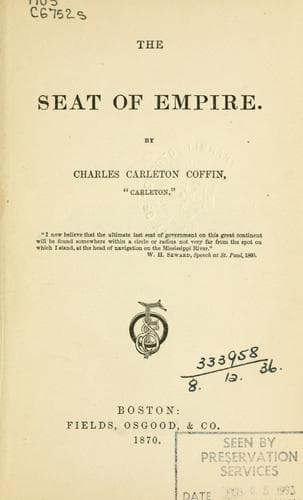
Minnesota -- Description and travel; Northwest, Canadian; Northwestern States; Red River of the North
"There is no goose so gray but soon or late
Will find some honest gander for her mate."
Not so in the East, for the young men there are pushing west, and women
are in the majority. It is a certainty that some of them will know more
of single blessedness than of married life. If they would only come out
here, the certainty would be the other way.
Not stopping at Winona, but hastening on board the train, we fly over
the prairie, up the ravine, and out through one of the most fertile
sections of the great grain-field of the Northwest.
The superintendent of the road, Mr. Stewart, accompanies our party,
and we receive pleasure and profit by having a gentleman with us who
is so thoroughly informed as he to point out the objects of interest
along the way. By a winding road, now running under a high bluff where
the limestone ledges overhang the track, now gliding over a high
trestle-bridge from the northern to the southern side of the deep
ravine, we gain at length the general table-land, and behold, reaching
as far as the eye can see, fields of wheat. Fences are visible here and
there, showing the division of farms; but there is scarcely a break in
the sea of grain, in flower now, rippling and waving in the passing
breeze. Farm-houses dot the landscape, and white cottages are embowered
in surrounding groves, and here and there we detect a small patch of
corn or an acre of potatoes,--small islands these in the great ocean of
wheat reaching westward, northward, and southward.
We are astonished when the train nears St. Charles, a town of two
thousand inhabitants, looking marvellously like a New England village,
to see a school-house just completed at a cost of $15,000! and still
wider open we our eyes at Rochester, with a population of six thousand,
where we behold a school-building that has cost $60,000! Upon inquiry
we ascertain that the bulk of the population of these towns is from New
England.
A ride of about ninety miles brings us to Owatona, a town of about
three thousand inhabitants.
We are in Steele County. The little rivulets here meandering through
the prairie and flowing southward reach the Mississippi only after
crossing the State of Iowa, while those running northward join the
Mississippi through the Minnesota River.
Here, as at Rochester, we behold charming landscapes, immense fields of
grain, groves of trees, snug cottages and farm-houses, and a thrifty
town. Owatona has a school-house that cost the citizens $20,000; yet
nine years ago the population of the entire county was only 2,862! The
census of 1870 will probably make it 15,000. So civilization advances,
not only here, but all through the Northwest, especially where there
are railroad facilities.
Public-domain text, read in full here on John Shaqi.
Reviews
Reviews
No reviews yet
Be the first to share your thoughts on this work.
Join the Discussion
Join the discussion
Sign in to leave a comment or review.
Sign InorCreate an account