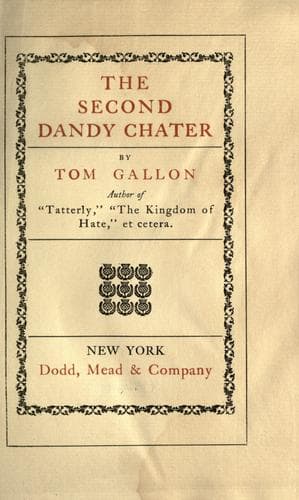
England -- Fiction; Impostors and imposture -- Fiction; Love stories; Mystery fiction
He picked up a stained newspaper, and tried to read; but before his
eyes, again and again, came the image of the dead face, which had
stared into his that night. So much had happened—so much that was wild
and strange—within the past few hours, that it all seemed like some
horrible unruly nightmare. Yet he knew that it was something more than
that; for his fingers touched the papers in his pocket, and the watch
that had belonged to the dead man. For a moment, as his hands closed
upon them, a sweat of fear broke out upon his forehead, and he glanced
about him uneasily.
“It’s a desperate game,” he muttered. “If the body should be found, and
recognised—or if the likeness be not so complete as I have
thought—what shall I say—what shall I do? Why—I don’t even know what
manner of man this Dandy Chater was—or what were his habits, his
companions, the places to which he resorted; I know absolutely nothing.
Every step of the way I must grope in the dark. And I may betray myself
at any moment!”
He dropped the paper from before his eyes, and found, to his
astonishment, and somewhat to his discomfiture, that he was being
steadily regarded, by a man who sat at the other side of the table.
More than that, the man, having his back towards the little inner room
where the meal was being prepared, nodded his head quickly, in a
familiar fashion, and bent forward, and whispered the following
astounding remark—
“Wot—give the Count the slip—’ave yer?”
Philip Crowdy’s position, at that moment, was not an enviable one. He
was utterly alone, in the sense that, whatever battles lay before him,
he had to fight them as best he could, and dared not trust any living
soul; worse than all, he must fight them in the dark, not knowing, when
he took one step, where the next might lead. Moreover, the man before
him was one of the most repulsive looking ruffians it is possible to
imagine—a man who, from his appearance, might have been one of those
unfortunates described by the proprietor of the place as never sleeping
in a bed. His clothes, which had once been black, were of a greenish
hue, from long exposure to the weather, and were fastened together, in
the more necessary places, by pins and scraps of string. His face, long
and thin and cadaverous, had upon it, besides its native dirt, a week’s
growth of beard and moustache; his hair—thin almost to baldness on the
top—hung long about his ears, and was rolled inwards at the ends, in
the fashion of some thirty years ago.
Crowdy, after eyeing this man for a few moments in silence, grunted
something inaudible, and took up the paper again.
“No offence, Dandy,” said the man, somewhat more humbly, and in the
same hoarse whisper as before. “Seed yer outside—an’ came in arter
yer. Agin the rules—an’ well I knows it; but there ain’t no one ’ere
to twig us—is there?”
“Well—what of that?” asked the other, taking his cue from the fellow’s
humility. “Can’t you let a man alone, even at this hour? What the devil
do you want now?”
Public-domain text, read in full here on John Shaqi.
Reviews
Reviews
No reviews yet
Be the first to share your thoughts on this work.
Join the Discussion
Join the discussion
Sign in to leave a comment or review.
Sign InorCreate an account