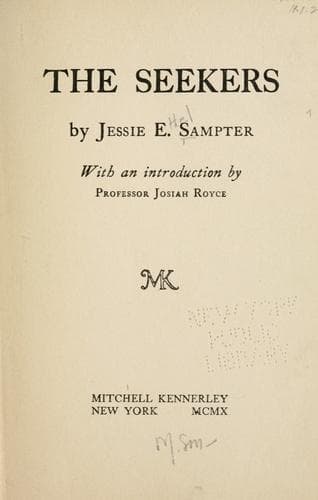
Philosophy and religion -- Study and teaching (Secondary) -- United States
“But,” I said, “if you didn’t do it, you would feel dissatisfied with
yourself. And therein lies the explanation of duty. Duty is a substitute
for love. It is the substitute the mind imposes on us when our feelings
will not fulfil the scheme of beauty and order which is our strongest
desire. To do your duty is to fulfil your strongest desire—lacking the
great love. Love shall overcome duty. Duty means only debt. It is
limited, small. It is the ugly framework that love must make before it
can build its beautiful dwelling-place. The strong man always does his
duty, because he flinches at nothing that is on the path, but more and
more he loses duty in love.”
Virginia said: “I think it is fun sometimes to hate things, such as
hating to go to school.”
“Why?”
“Because to do a thing you hate to do makes you feel good sometimes. I
like it.”
“We have come to love the hard thing,” I said, “because it is the
growing thing. We get to fancy that when we do something hard we must be
getting ahead, because generally it is true.”
Virginia said: “I like the poem by Rebecca of Sunnybrook Farm:
‘When joy and duty clash,
Let duty go to smash.’”
“I wish joy and duty were the same,” I said, “and that is just what they
are when love conquers. You have to do your duty when love fails, and so
it often seems an unpleasant job.”
I spoke now of promises, and of how unnecessary they would be were it
not for our failures in love. Then we went on to speak of obedience. We
said that where love was perfect one would not think of obedience or
disobedience. Obedience is a substitute for understanding. He who
understands does not obey. He acts. We spoke of necessary obedience, the
substitute, and then of the family where parents and children were so
much at one that obedience was never mentioned.
“A person out of such a home,” said Virginia, “would not have enough to
struggle against. I don’t like people who are just perfect, and have
nothing to overcome.”
“We will never reach perfection,” they said; and they all, save Henry,
agreed with me that the greatest joy in life was working for, rather
than achieving our desires.
“But when we reach perfection,” he said, “we won’t wish for it any
more.”
I refused to argue that problematic point.
I said: “Be sure the strong and good man will always find something
still to fight and overcome.”
We spoke now of how disobedience might be a virtue, of the rebels in
wars for freedom, and the child who would refuse to obey his parents, if
they ordered him to do what he thought bad; the thief’s child, for
example.
I said: “The framework is for the house—not for itself—and if it
doesn’t suit the house, it must be pulled down.”
Public-domain text, read in full here on John Shaqi.
Reviews
Reviews
No reviews yet
Be the first to share your thoughts on this work.
Elsewhere in the archive
Join the Discussion
Join the discussion
Sign in to leave a comment or review.
Sign InorCreate an account