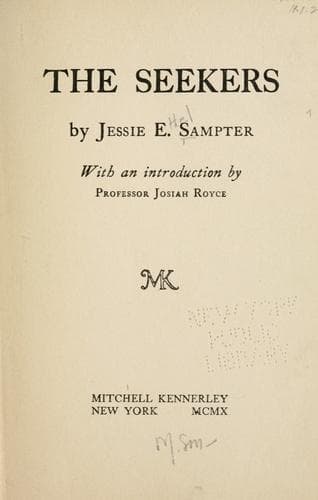
Philosophy and religion -- Study and teaching (Secondary) -- United States
Henry remarked that perhaps, when she was looking out of the window, she
studied the landscapes.
At this point Marian, hearing voices in the next room, whispered to Ruth
whether she knew who was there.
“Strange,” I said. “Until you spoke of it, I did not notice any voices.
Do you love this club? Well, I do, too; and when I am here, no matter
what happened before, or will happen afterward, or may be happening now,
I think of nothing but what we are doing, I forget everything else. Do
you remember the difference between the painting and the photograph? The
photographic plate takes every detail, unimportant and meaningless; the
picture contains only that which makes it complete and beautiful. Let
your life be a picture, not a photograph. Do not let your life be a
sensitive plate that cannot defend itself against any impression. Let it
be an artist’s work, chosen, complete, beautiful. Leave out what does
not concern you.
“Now, what is it,” I asked, “which all of us do love best, and which
includes all our lesser loves?”
Henry answered: “You mean complete sympathy and understanding.”
“Yes,” I went on, “and all our lives are different, definite expressions
of that desire.”
We spoke a few words of those people who mistake the means for the end,
who make an end of business, athletics, or even study, so that they
forget these are only a means to the end, and destroy or waste their own
powers in some pettiness.
“Each life,” I said, “must be a different, definite expression of the
longing for unity.”
“Definite?” asked Marian again. “If I were always to be thinking what
sort of person I meant to be, I would be dreadfully self-conscious.”
“No,” I said, “you would not think it, you would live it. Desire is a
habit. Self-consciousness of the stilted sort attempts to realize what
sort of person you appear or are, and then to act your part. Then you
usually fail, and you are usually wrong in your estimate. But know what
you long to be; and then be it, because of your strong desire. It is not
necessary to have chosen your life-work now, but you will choose it some
day, and meanwhile you want to be ready and open for it. You and Alfred
have not yet chosen, nor need choose. But the others believe they have
chosen. And there is no reason why each one should not do just what he
sets out to do. Each life and each moment of each life is tremendously
important. Each man is as great as he loves to be. The difference
between the great genius and the common, scattered man, is the
difference in desire. Great desire makes great deeds. It is not so much
capacity, so called, as the desire, the concentration and the belief
that you can.”
“Self-confidence,” they said.
“Yes, surely. When a man has his call, when he feels that he must do a
thing, then he can. Did you ever think of the word ‘calling,’ what a
tremendous thing it means?”
“Vocation,” said Ruth.
Public-domain text, read in full here on John Shaqi.
Reviews
Reviews
No reviews yet
Be the first to share your thoughts on this work.
Elsewhere in the archive
Join the Discussion
Join the discussion
Sign in to leave a comment or review.
Sign InorCreate an account