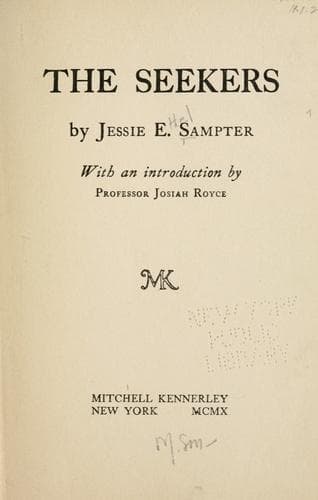
Philosophy and religion -- Study and teaching (Secondary) -- United States
“Yes,” I said, “your vocation. Some of us have our call early, and some
late, but we can always follow it to the end with love and courage. I
believe that each one of you is going to do great things. I want you to
believe that you are going to be great, for then you will.”
Henry said: “I mean to be a great man. I know I can, if I work for it.
When some one found fault with me for criticizing Lincoln, because I was
nobody, I answered that I meant to be greater than Lincoln. And I do.”
“And you shall. And I believe that Virginia will be as great an artist
as she means to be. And I believe that if Florence persists, she shall
dance better than Isadora Duncan, and make of dancing a great and noble
art.”
“It _is_ so,” said Marian and Ruth. “It is an expression of the highest
art.”
“Surely it is,” I said. “And I believe that Ruth will reform the whole
kindergarten system, and give us new and finer ideas on education.”
“I will,” said Ruth.
“I believe it and know it, too,” said Marian; “she had her call early.
She has always been teaching little children.”
“Ambition is good,” I said; “it is best. He who desires great things
will do greatly. Genius is desire. And great genius is most desire.
“Each one,” I said, “will then be a person with a meaning, but for all
that a large, many-sided person. Do you understand, Marian? In a picture
there is light and shade, and contrast makes completeness. So in life,
rest and work and play, merriment and seriousness, study and exercise,
and all the many different things that make up life are needed to make
it whole. I believe in concentration, in variety.”
“What do you mean,” asked Florence, “by concentration in variety?”
“I mean,” I said, “that we will make every activity in life the sort we
need, that our pleasures will suit our studies. Our taste and liking in
every kind of thing will harmonize. We will like only good nonsense.
Even our recreation must have a certain character, and satisfy our
taste. Each person stands for a definite vision of life.”
Virginia said: “At the academy show last year, you remember that picture
by Pischoto of an Italian garden, with a fountain? It was calm, the
water poured down softly, all was still. At the Spanish exhibition, I
saw a picture by Sorolla of the same spot; but it was jubilant, the
water leaped, the sun sparkled, everything was gay. It was the
difference in temperament that made the same spot unlike.”
“Yes,” I said; “I am glad you told us that. For I believe each person
must be a rhythm in life, must stand for himself, and be a force and a
measure of life to those about him.”
We spoke a few words more, to make this clear; and then I read to them
two slips from the Ruskin calendar, which Ruth had brought:
“All that is highest in Art, all that is creative and imaginative is
formed and created by every artist for himself, and cannot be repeated
or imitated by others.”
Public-domain text, read in full here on John Shaqi.
Reviews
Reviews
No reviews yet
Be the first to share your thoughts on this work.
Elsewhere in the archive
Join the Discussion
Join the discussion
Sign in to leave a comment or review.
Sign InorCreate an account