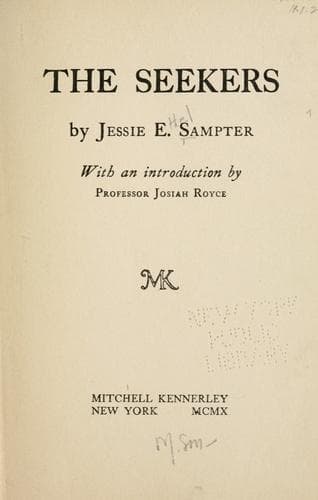
Philosophy and religion -- Study and teaching (Secondary) -- United States
and inhumanity in belief, are great evils, against which the young
people of our time need to be guarded quite as much as men needed to be
guarded against such evils in the days either of the Sophists or of the
Inquisitors. For, in one guise or another, speaking the language of old
or of new faith or unfaith, Sophists and Inquisitors we have always with
us, either corrupting or oppressing the youth. The methods of our
author, as set forth in this book, make for liberty together with
seriousness, for self-expression together with reverence, for
thoughtfulness together with a sense of deeper values. And in so far the
book is a success as a model of the way in which our new problems must
be met when we have to deal with the young.
If one undertakes to consider such topics with a class as youthful and
at the same time as enlightened as the “Seekers,” the dilemma is
obvious. One must indeed be more or less dogmatic in tone about at least
some central interest; one must make use of the persuasive power of a
teacher’s personal influence; or else one will lead to no definite
results. On the other hand, if one propounds one’s dogmas merely as the
traditional teacher of religion has always done by saying: “This is our
faith. This is what you should believe,”—one is then in no case
teaching philosophy, and one is hardly helping the young people to
“seek.” Moreover, such mere dogmas, addressed to young people in whom
the period of “enlightenment” has already begun, will tend to awaken in
their minds new doubts and objections, rather than to convey to them the
positive truth, even if one’s own dogmas happen to be true. Hence arises
a problem of instruction which cannot be solved in the case of these
“Seekers” as we teachers of philosophy often try nowadays to solve our
analogous problems in dealing with older pupils in college. Some of us
meet our own problems with the older students by directly disclaiming
all authority to control their convictions, by asking them to become as
self-critical and independent as they can, and by stating our own
opinions with the intent _not_ to make disciples, but to enable our
students to form their own personal judgments through the very sympathy
with our efforts to be reflective, self-critical and constructive. Thus
we do not try to convey a faith so much as to help our students to their
own spiritual independence.
Public-domain text, read in full here on John Shaqi.
Reviews
Reviews
No reviews yet
Be the first to share your thoughts on this work.
Join the Discussion
Join the discussion
Sign in to leave a comment or review.
Sign InorCreate an account