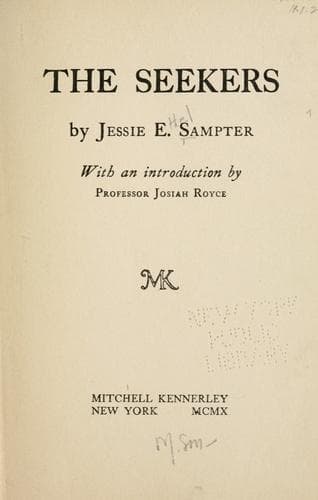
Philosophy and religion -- Study and teaching (Secondary) -- United States
“To-day we first went over what we had said last week. The question
arose as to which class of evil disease belongs. We came to the
conclusion that it is the result or price of progress. We also spoke
about the idea of a trinity. We had said at the last meeting that God is
a divine self within us, and that when we know each other we will know
God. Connecting each one of us to the other, there is a feeling of
sympathy, a third element. That is to say, there is you, and myself,
and, making the third part, that sympathetic understanding which brings
us closer together.
“The chief topic to-day was that of Matter and Spirit. At first there
was a little difference of opinion, but we finally agreed that in
reality everything is spirit, and that which we call matter is only the
expression of the spirit. As an example we took the sculptor, who,
getting an idea through the mind, expresses this spirit in a statue,
which we call matter. We speak of the body as matter, but it is spirit,
in as much as it is the medium through which the spirit manifests
itself.”
When I told the children I had decided to take up evolution before
immortality, because evolution was the problem of creation, they were
all satisfied and interested.
Then I read aloud Marian’s little paper:
“On Sunday, October 25th, the Seekers held a regular meeting. We first
reviewed our discussion of the last week, and then took up the subject
of Matter and Spirit. Our discussion was long, and the conclusion we
reached was that matter is an expression of spirit. In the first place,
matter is that which has form or qualities. Every material thing is the
expression of a thought. If a man makes a table, he does so because he
wishes to, because it is his will to do so. If he writes a book, that
book is an expression of his thought, but it is what is commonly called
matter. Matter is, in short, a result of spirit, is an expression of
spirit. Our bodies are the expression of our minds, and the way in which
we express ourselves to each other. If our bodies are not perfect, if
they are diseased, it is merely that our minds have not advanced far
enough to express the perfect body. Our talk this week helped me a great
deal. Although we did not cover much ground, we reached a conclusion on
one of the most difficult subjects, and I think almost every one was
convinced.”
Ruth said she had thought all the week of what I had told them, and that
she was sure she agreed with me now. The children’s thoughts seem to
develop during the week, as if they shaped afterward, and slowly, all
that had been said.
Virginia disagreed with Marian, that the perfect mind would make the
perfect body. She said: “People with perfect bodies are often fools. And
sickly people are often the most intelligent and fine spirited.”
Public-domain text, read in full here on John Shaqi.
Reviews
Reviews
No reviews yet
Be the first to share your thoughts on this work.
Join the Discussion
Join the discussion
Sign in to leave a comment or review.
Sign InorCreate an account