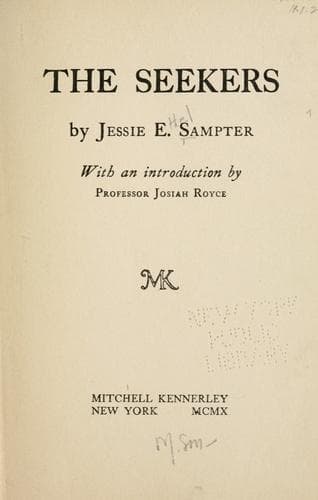
Philosophy and religion -- Study and teaching (Secondary) -- United States
“This one-celled animal, after a while, divided into more cells,
and thus became more complicated. When land appeared, land
animals and plants came into existence. And these animals became
higher and higher. First the animals without a spine, then a
more complicated specimen, in the lower forms of vertebrates.
Then the reptiles, out of which came two branches, the birds and
the immense reptiles of which none have survived that I know of.
But out of them came the mammals. And after many thousands of
years, man appeared.
“At first man was more like an animal, but after centuries he
became less savage. He made implements for himself, and lived in
tribes with his fellow men; and the more highly civilized man
becomes, the more will he sympathize with the rest of mankind,
so that when the highest civilization arrives, it will only mean
complete love of all living things.”
I insisted that the theory of germ transmission was not a fact. I said
she seemed to have avoided natural selection, that I thought she did not
like it because it was too mathematical and too logical for her. Ruth
thought perhaps that was why she did not like it much, either, though it
interested her. I said: “It seems at first so ‘cruel’ a theory; it
repels us until we remember that what is cruel in a man is not so in a
beast.” Virginia answered that she did not think it cruel, because it
was not meant cruelly. “They had to kill each other,” she said. Henry
asked me whether I thought it cruel to eat animals. I answered it was
not cruel, unless they were cruelly killed. Ruth added that some time we
would get beyond the need of eating animals. “To hunt for fun is
wicked,” said Virginia.
Marian said: “Perhaps we think natural selection not so cruel among
animals, because we did not do the suffering.”
The children all said they did not remember just what relation evolution
had to our idea of life. I answered that the very fact that we could not
go on in our thought without it proved its relation, and that we would
constantly come back to it, that I did not need to explain it now.
Then we spoke of prayer. I asked each one in turn what and how much they
had thought of it.
Alfred said he had never thought of it, that he had prayed as a baby,
but had stopped early and never felt the need. Florence said the same.
Henry said he believed in prayer, especially in prayer for strength in
any undertaking. “Of course,” he went on, “I don’t expect to be helped
against the other fellow, but I get strength in praying for strength.”
“I agree with you,” said Ruth, “only don’t you pray to know whether you
are right or not? For you might be wrong.”
“If I thought I might be wrong,” he answered, “I wouldn’t be doing the
thing I was doing.” They argued it a bit. “But,” he went on, “I have no
set formula for prayer, nor a definite time.”
Public-domain text, read in full here on John Shaqi.
Reviews
Reviews
No reviews yet
Be the first to share your thoughts on this work.
Join the Discussion
Join the discussion
Sign in to leave a comment or review.
Sign InorCreate an account