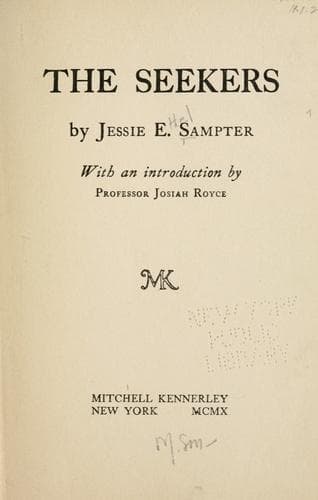
Philosophy and religion -- Study and teaching (Secondary) -- United States
I said that to me as to him it seemed as if, were there not immortality
for the self, the world itself might shrivel up and disappear. A world
without immortality would be a mad world, without reason; and, as
everything else seems reasonable to me, I believe the world to be
reasonable. I spoke, too, of the danger of believing things simply
because we liked them. I told them how I had disbelieved in immortality
at one time, because I suddenly found I had only believed what pleased
me.
Virginia said: “I believe things because I like them. But may not that
liking, that feeling, in itself be a sign of truth?”
“No,” I answered; “liking is no proof or sign.”
Marian said: “But it is only because we care, because we wish to
believe, that we begin to think of these things.”
“Yes,” I replied, “we must care. But then we must bravely face the
truth.”
Marian told us she had never been taught anything on this subject, but
that gradually her belief had grown, and that her talks with Ruth had
helped her from her ideas.
I said many people believed in “personal” immortality; that is,
immortality with memory, and the meeting of those we love. I do not
pretend to know, or to have a definite opinion. But I think the results
of life are eternal, even if not in precise memories. I asked the
children for opinions. None of them seemed to believe, or care to
believe, in distinct personal immortality.
Ruth said: “We would surely meet those we had loved, in that complete
whole self, even though it were not as persons.”
I was surprised and glad to hear her say it. I had said to the children
that they probably believed, and might easily believe, much beyond what
I told them, but this was all which I believed; I would tell them no
theories or surmises of mine, of which I could not feel certain. They
were urgent in asking me please to tell them some theories, but I
refused.
Virginia said she believed in transmigration. I think it possible, as I
told her; it is in every way consistent with progress and all things in
life, but I have no reason for feeling sure of it. She said: “It must be
true, for if there is just so much spirit in the world, forever and
ever, and if it must express itself through matter, how can there be
anything but transmigration? Some time we may all live again on some
other planet, in some other shape.” I said it might be so.
The children asked me whether I believed animals were immortal. I
answered that as much life and self as is in them must be immortal. I
observed that this idea of animal-immortality was consistent with
Virginia’s belief in transmigration, that so each least creature might
rise through successive stages toward its complete self.
Then I said to the children that, of course, if we believed we had been
nothing before we were born, we could easily believe in extinction. But
I, for one, believed, yes, knew, that I had been forever, that I was not
“made” in these few years.
Public-domain text, read in full here on John Shaqi.
Reviews
Reviews
No reviews yet
Be the first to share your thoughts on this work.
Join the Discussion
Join the discussion
Sign in to leave a comment or review.
Sign InorCreate an account