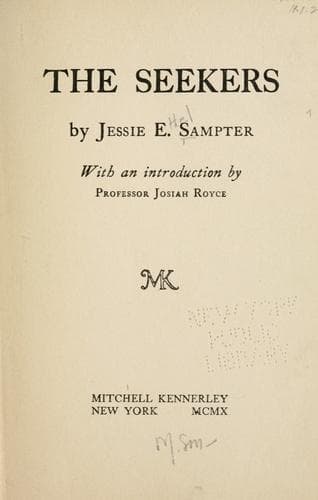
Philosophy and religion -- Study and teaching (Secondary) -- United States
Next we will consider art, creative genius, in relation to our idea. I
was glad the children agreed with me in preferring this to moral
disputations. I said I thought the longer we waited to speak of moral
questions, the larger view we would take of them. I wanted to avoid
pettiness.
Our subject for next week grew naturally out of this week’s talk. I
said: “As a drop of water can be a sphere as perfect as the suns and
planets, so each smallest thing, if it be perfect in itself, typifies
the universe. You must realize that in an infinite universe there is
really no such thing as size.”
“There is only comparative size,” said Virginia.
“Yes,” I answered; “and it is with this idea in mind that I wish to
consider beauty, and the definite separate creation. I shall want to
know next week what each of you means by beauty, or thinks beautiful.”
Marian—thinking of the personal side immediately—said: “I think it’s
because most people are homely, that we think some beautiful.”
We were amused at that. I said I did not mean personal beauty in
particular. Then they asked, did I mean artistic beauty? I meant beauty
in anything. I would want to know what made certain things seem
beautiful to us.
Virginia said: “I think there is nothing so beautiful as taking a deep,
deep breath. That brings beautiful thoughts into my head, and makes
everything right.”
This remark did not seem pertinent to any of us. Virginia insisted, too,
that she thought a man was an artist, even if he could not express
himself; that to have artistic thoughts made one an artist. I answered,
it might be so; work itself was not good art unless it was a good
expression, no matter what the artist might be. Virginia explained: “I
mean an artist is more interesting than his work, sometimes.”
Florence said: “A beautiful thing—in art—is a complete thing, complete
and perfect in itself.”
“I don’t think so,” answered Virginia. “If you were to sketch a
tree—without finishing it at all—and that sketch were your whole idea
of the tree as you saw it, then it would be no sketch, but a finished
picture. A thing is a sketch until you have altogether expressed your
idea. But then, no matter how sketchy it may look, it is finished.”
I had to interpret Florence to Virginia. I said: “Florence did not mean
completeness in the sense of exactness. She meant that the tree, no
matter how indicated, must seem to us so complete, in a world of its
own, as to leave nothing lacking or intruding; that everything in the
picture is there in relation to the tree, and the whole makes a perfect
little world. If there were suggestions of other things which had
nothing to do with the tree, such as there always are in life, it would
not be a perfect picture. You said it must be a complete expression of
the artist’s thought. That is just the completeness Florence means. It
must be a complete, self-sufficient harmonious vision of a tree. And
harmony means wholeness, doesn’t it?”
Public-domain text, read in full here on John Shaqi.
Reviews
Reviews
No reviews yet
Be the first to share your thoughts on this work.
Join the Discussion
Join the discussion
Sign in to leave a comment or review.
Sign InorCreate an account