Philosophy and religion -- Study and teaching (Secondary) -- United States
JOSIAH ROYCE
Harvard University, August 3, 1910.
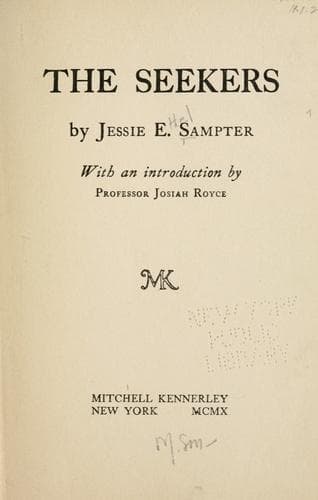
THE SEEKERS
THE BEGINNING
This is a live book. It was lived first, and written only afterwards. So
it can lay no claim to the title of art, which is experience remoulded
in the cast of individual genius; for this was not at all moulded, save
as the written word reshapes the spoken. It is a philosophic adventure,
an experiment, written down by one, but lived by seven.
Why did I write it down? may be asked. Every new book needs an excuse
for being. I wrote it down because it seemed an answer, perhaps a
partial, but still a living answer, to two questions that cry aloud.
As I look about me, and observe the doings and thoughts of men and women
in this active time, I notice two problems, related one to the other,
and wanting but one solution.
First of these is a lack of common purpose in the works of life. Many
religions are there, many creeds and anti-creeds, many purposes, from
petty, selfish gain to reforms in government and social service.
Scientist, politician, artist, philanthropist and minister go each
toward a partial goal, in opposition to one another, with no one
purpose, no end beyond all lesser ends, no larger patriotism. Morals are
either very stiff or very lax, without any conscious reason for either
their stiffness or their laxity. The only reason for moral conviction,
the only purpose that could unite all purposes, the only patriotism to
hold all men together and give the union needful for great and strong
achievement, is a common faith in the goal and meaning of life.
The second problem is a more conscious one, the problem of moral and
religious education for our children. For ourselves—so think many among
us—we do not need a philosophy or religion; we are good enough without
having any reason for being good. But we think our children need some
instruction and guidance, something to satisfy the blessed cravings and
doubts that we have long since killed within ourselves. For barely one
among us fails to remember his fifteen-year-old questionings and
strivings, and his defeat, when at last he decided to think no more,
because his problem was insoluble. But even these who are so well
contented with their own hard-won torpor want something better for their
children. The question is asked again and again: “Shall we teach our
children what we do not believe? And can we teach them what we do
believe?”
Public-domain text, read in full here on John Shaqi.
Reviews
Reviews
No reviews yet
Be the first to share your thoughts on this work.
Join the Discussion
Join the discussion
Sign in to leave a comment or review.
Sign InorCreate an account