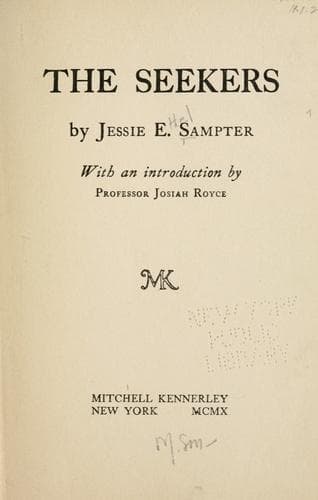
Philosophy and religion -- Study and teaching (Secondary) -- United States
I went on to the last law, which was the only one I had some trouble in
making clear. I asked why was the photograph inartistic? They said
because of inharmonious details. I asked, why is the statue more
beautiful than wax works? Henry spoke again of the “distance” of
material, which just thereby appealed to the sympathies. I wanted to
speak of the artist’s aloofness, how he was creator of his work, within
it, and yet around it and above it. They did not understand. They said,
if he were above it, he would be unsympathetic. They did not understand
the creator’s attitude toward himself, the created; the dramatic
attitude in life, in which we are both actor and spectator. Marian said
she thought she understood it. “Haven’t you ever laughed at yourself?”
she asked the others.
“I have sworn at myself,” said Leo.
I meant to pass by the subject, and leave out the last law, rather than
arouse a self-consciousness, which was the opposite of what I hoped to
awaken. But unintentionally the conversation led to a better
understanding.
I spoke again of reverence, as I had done to Alfred, of the small self
awed in supreme moments, before the immensity of its whole self.
“Do you mean,” asked Leo, “that it makes us feel how small we are?”
I tried to make it clear. I spoke of the feeling of nothingness that
overcomes us, when we stand under the stars at night, and realize them
as worlds and suns, and our planet as a dot of light in immensity.
They had all felt so, except Henry.
He said: “It does not make me feel small. I feel that I am a part of it
all, and one with the universe.”
“Yours is the true feeling,” I answered, “for you are, indeed, a part of
it, and the realization of it is within yourself. A kitten in your place
would not feel it.”
“I know,” said Marian, “that many people do not feel it. For I have
sometimes walked with some one out in the night, or by the sea, and
could not speak. And suddenly they said some trivial thing, which showed
they did not feel as I did.”
Alfred said he felt overawed by the sea, because it was so strong and
big.
“You mean,” I asked, “that it makes you feel helpless before its might?”
“Yes.”
“It has been said,” Henry went on, “that one cannot be an astronomer and
not worship, I believe it is true.”
“And now,” I said, “we are coming to the seventh law after all. For by
aloofness I mean that the artist, during his act of creation, feels his
own immense self, feels the whole universe, and sees himself and all
other things as a part in relation to it.”
“I have felt that way sometimes,” said Florence, “just for a moment.”
“It is a momentary realization,” I answered.
“Don’t you think,” asked Ruth, “that it is a superior feeling, though; a
cold, perfect feeling?”
“No,” I answered; “though it lifts us above petty concern for ourselves,
it does not lift us out of sympathy and action.”
Henry said: “When I go to Riverside and see all the lights, and think of
the millions of people, I feel them all.”
Public-domain text, read in full here on John Shaqi.
Reviews
Reviews
No reviews yet
Be the first to share your thoughts on this work.
Elsewhere in the archive
Join the Discussion
Join the discussion
Sign in to leave a comment or review.
Sign InorCreate an account