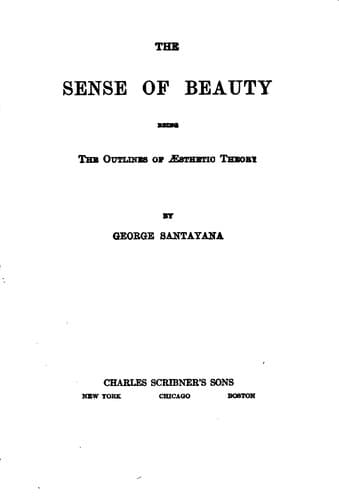
The Sense of Beauty: Being the Outlines of Aesthetic TheorySantayana, George
Philosophy
The Sense of Beauty: Being the Outlines of Aesthetic Theory
Santayana, George
Aesthetics
The poet, therefore, who wishes to delineate a character need not
keep a note-book. There is a quicker road to the heart -- if he has
the gift to find it. Probably his readers will not themselves have
kept note-books, and his elaborate observations will only be
effective when he describes something which they also happen to
have noticed. The typical characters describable by the empirical
method are therefore few: the miser, the lover, the old nurse, the
ingenue, and the other types of traditional comedy. Any greater
specification would appeal only to a small audience for a short
time, because the characteristics depicted would no longer exist to
be recognized. But whatever experience a poet's hearers may have
had, they are men. They will have certain imaginative capacities to
conceive and admire those forms of character and action which,
although never actually found, are felt by each man to express
what he himself might and would have been, had circumstances
been more favourable.
The poet has only to study himself, and the art of expressing his
own ideals, to find that he has expressed those of other people. He
has but to enact in himself the part of each of his personages, and if
he possesses that pliability and that definiteness of imagination
which together make genius, he may express for his fellows those
inward tendencies which in them have remained painfully dumb.
He will be hailed as master of the human soul. He may know
nothing of men, he may have almost no experience; but his
creations will pass for models of naturalness, and for types of
humanity. Their names will be in every one's mouth, and the lives
of many generations will be enriched by the vision, one might
almost say by the friendship, of these imaginary beings. They have
individuality without having reality, because individuality is a
thing acquired in the mind by the congeries of its impressions.
They have power, also, because that depends on the appropriateness
of a stimulus to touch the springs of reaction in the soul.
And they of course have beauty, because in them is embodied
the greatest of our imaginative delights, -- that of giving body to
our latent capacities, and of wandering, without the strain and
contradiction of actual existence, into all forms of possible being.
_The religious imagination._
Public-domain text, read in full here on John Shaqi.
Reviews
Reviews
No reviews yet
Be the first to share your thoughts on this work.
Elsewhere in the archive
Join the Discussion
Join the discussion
Sign in to leave a comment or review.
Sign InorCreate an account