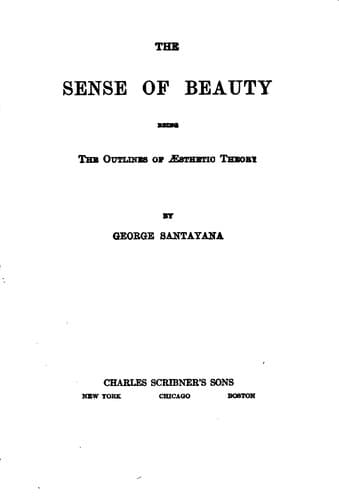
The Sense of Beauty: Being the Outlines of Aesthetic TheorySantayana, George
Philosophy
The Sense of Beauty: Being the Outlines of Aesthetic Theory
Santayana, George
Aesthetics
Sec. 47. The greatest of these creations hare not been the work of any
one man. They have been the slow product of the pious and poetic
imagination. Starting from some personification of nature or some
memory of a great man, the popular and priestly tradition has
refined and developed the ideal; it has made it an expression of
men's aspiration and a counterpart of their need. The devotion of
each tribe, shrine, and psalmist has added some attribute to the god
or some parable to his legend; and thus, around the kernel of some
original divine function, the imagination of a people has gathered
every possible expression of it, creating a complete and beautiful
personality, with its history, its character, and its gifts. No poet has
ever equalled the perfection or significance of these religious
creations. The greatest characters of fiction are uninteresting and
unreal compared with the conceptions of the gods; so much so that
men have believed that their gods have objective reality.
The forms men see in dreams might have been a reason for
believing in vague and disquieting ghosts; but the belief in
individual and well-defined divinities, with which the visions of
the dreams might be identified, is obviously due to the intrinsic
coherence and impressiveness of the conception of those deities.
The visions would never have suggested the legend and attributes
of the god; but when the figure of the god was once imaginatively
conceived, and his name and aspect fixed in the imagination, it
would be easy to recognize him in any hallucination, or to interpret
any event as due to his power. These manifestations, which
constitute the evidence of his actual existence, can be regarded as
manifestations of him, rather than of a vague, unknown power,
only when the imagination already possesses a vivid picture of him,
and of his appropriate functions. This picture is the work of a
spontaneous fancy.
No doubt, when the belief is once specified, and the special and
intelligible god is distinguished in the night and horror of the
all-pervading natural power, the belief in his reality helps to
concentrate our attention on his nature, and thus to develope and
enrich our idea. The belief in the reality of an ideal personality
brings about its further idealization. Had it ever occurred to any
Greek seer to attribute events to the influence of Achilles, or to
offer sacrifices to him in the heat of the enthusiasm kindled by the
thought of his beauty and virtue, the legend of Achilles, now
become a god, would have grown and deepened; it would have
been moralized like the legend of Hercules, or naturalized like that
of Persephone, and what is now but a poetic character of
extraordinary force and sublimity would have become the adored
patron of generation after generation, and a manifestation of the
divine man.
Public-domain text, read in full here on John Shaqi.
Reviews
Reviews
No reviews yet
Be the first to share your thoughts on this work.
Elsewhere in the archive
Join the Discussion
Join the discussion
Sign in to leave a comment or review.
Sign InorCreate an account