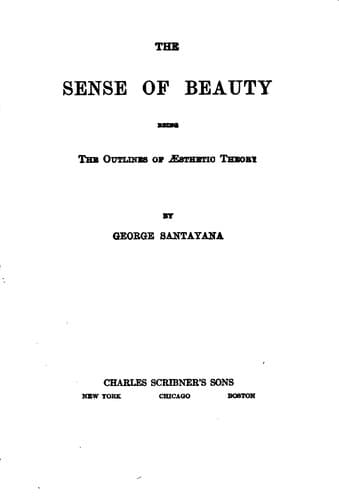
The Sense of Beauty: Being the Outlines of Aesthetic TheorySantayana, George
Philosophy
The Sense of Beauty: Being the Outlines of Aesthetic Theory
Santayana, George
Aesthetics
Since these aesthetic effects include some of the most moving and
profound beauties, philosophers have not been slow to turn the
unanalyzed paradox of their formation into a principle, and to
explain by it the presence and necessity of evil. As in the tragic and
the sublime, they have thought, the sufferings and dangers to
which a hero is exposed seem to add to his virtue and dignity, and
to our sacred joy in the contemplation of him, so the sundry evils
of life may be elements in the transcendent glory of the whole.
And once fired by this thought, those who pretend to justify the
ways of God to man have, naturally, not stopped to consider
whether so edifying a phenomenon was not a hasty illusion. They
have, indeed, detested any attempt to explain it rationally, as
tending to obscure one of the moral laws of the universe. In
venturing, therefore, to repeat such an attempt, we should not be
too sanguine of success; for we have to encounter not only the
intrinsic difficulties of the problem, but also a wide-spread and
arrogant metaphysical prejudice.
For the sake of greater clearness we may begin by classifying the
values that can enter into expression; we shall then be better able to
judge by what combinations of them various well-known effects
and emotions are produced. The intrinsic value of the first term can
be entirely neglected, since it does not contribute to expression. It
does, however, contribute greatly to the beauty of the expressive
object. The first term is the source of stimulation, and the
acuteness and pleasantness of this determine to a great extent the
character and sweep of the associations that will be aroused. Very
often the pleasantness of the medium will counterbalance the
disagreeableness of the import, and expressions, in themselves
hideous or inappropriate, may be excused for the sake of the object
that conveys them. A beautiful voice will redeem a vulgar song, a
beautiful colour and texture an unmeaning composition. Beauty in
the first term -- beauty of sound, rhythm, and image -- will make
any thought whatever poetic, while no thought whatever can be so
without that immediate beauty of presentation.[14]
_Aesthetic value in the second term._
Public-domain text, read in full here on John Shaqi.
Reviews
Reviews
No reviews yet
Be the first to share your thoughts on this work.
Elsewhere in the archive
Join the Discussion
Join the discussion
Sign in to leave a comment or review.
Sign InorCreate an account