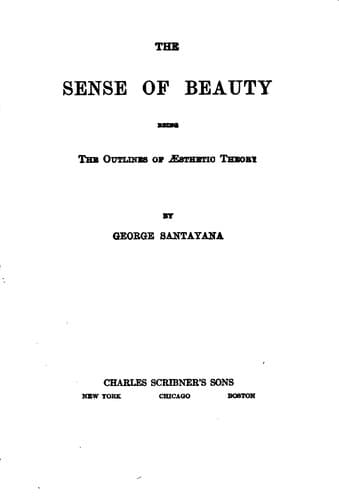
The Sense of Beauty: Being the Outlines of Aesthetic TheorySantayana, George
Philosophy
The Sense of Beauty: Being the Outlines of Aesthetic Theory
Santayana, George
Aesthetics
Sec. 51. That the noble associations of any object should embellish
that object is very comprehensible. Homer furnishes us with a
good illustration of the constant employment of this effect. The
first term, one need hardly say, leaves with him little to be desired.
The verse is beautiful. Sounds, images, and composition conspire
to stimulate and delight. This immediate beauty is sometimes used
to clothe things terrible and sad; there is no dearth of the tragic in
Homer. But the tendency of his poetry is nevertheless to fill the
outskirts of our consciousness with the trooping images of things
no less fair and noble than the verse itself. The heroes are virtuous.
There is none of importance who is not admirable in his way. The
palaces, the arms, the horses, the sacrifices, are always excellent.
The women are always stately and beautiful. The ancestry and the
history of every one are honourable and good. The whole Homeric
world is clean, clear, beautiful, and providential, and no small part
of the perennial charm of the poet is that he thus immerses us in an
atmosphere of beauty; a beauty not concentrated and reserved for
some extraordinary sentiment, action, or person, but permeating
the whole and colouring the common world of soldiers and sailors,
war and craft, with a marvellous freshness and inward glow. There
is nothing in the associations of life in this world or in another to
contradict or disturb our delight. All is beautiful, and beautiful
through and through.
Something of this quality meets us in all simple and idyllic
compositions. There is, for instance, a popular demand that stories
and comedies should "end well." The hero and heroine must be
young and handsome; unless they die, -- which is another matter, --
they must not in the end be poor. The landscape in the play must
be beautiful; the dresses pretty; the plot without serious mishap. A
pervasive presentation of pleasure must give warmth and ideality
to the whole. In the proprieties of social life we find the same
principle; we study to make our surroundings, manner, and
conversation suggest nothing but what is pleasing. We hide the
ugly and disagreeable portion of our lives, and do not allow the
least hint of it to come to light upon festive and public occasions.
Whenever, in a word, a thoroughly pleasing effect is found, it is
found by the expression, as well as presentation, of what is in itself
pleasing -- and when this effect is to be produced artificially, we
attain it by the suppression of all expression that is not suggestive
of something good.
Public-domain text, read in full here on John Shaqi.
Reviews
Reviews
No reviews yet
Be the first to share your thoughts on this work.
Elsewhere in the archive
Join the Discussion
Join the discussion
Sign in to leave a comment or review.
Sign InorCreate an account