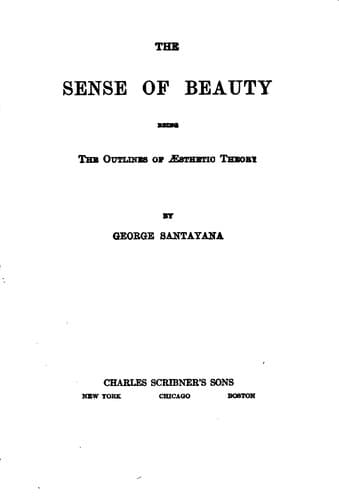
The Sense of Beauty: Being the Outlines of Aesthetic TheorySantayana, George
Philosophy
The Sense of Beauty: Being the Outlines of Aesthetic Theory
Santayana, George
Aesthetics
If our consciousness were exclusively aesthetic, this kind of
expression would be the only one allowed in art or prized in nature.
We should avoid as a shock or an insipidity, the suggestion of
anything not intrinsically beautiful. As there would be no values
not aesthetic, our pleasure could never be heightened by any other
kind of interest. But as contemplation is actually a luxury in our
lives, and things interest us chiefly on passionate and practical
grounds, the accumulation of values too exclusively aesthetic
produces in our minds an effect of closeness and artificiality. So
selective a diet cloys, and our palate, accustomed to much daily
vinegar and salt, is surfeited by such unmixed sweet.
Instead we prefer to see through the medium of art -- through the
beautiful first term of our expression -- the miscellaneous world
which is so well known to us -- perhaps so dear, and at any rate so
inevitable, an object. We are more thankful for this presentation, of
the unlovely truth in a lovely form, than for the like presentation of
an abstract beauty; what is lost in the purity of the pleasure is
gained in the stimulation of our attention, and in the relief of
viewing with aesthetic detachment the same things that in practical
life hold tyrannous dominion over our souls. The beauty that is
associated only with other beauty is therefore a sort of aesthetic
dainty; it leads the fancy through a fairyland of lovely forms,
where we must forget the common objects of our interest. The
charm of such an idealization is undeniable; but the other
important elements of our memory and will cannot long be
banished. Thoughts of labour, ambition, lust, anger, confusion,
sorrow, and death must needs mix with our contemplation and lend
their various expressions to the objects with which in experience
they are so closely allied. Hence the incorporation in the beautiful
of values of other sorts, and the comparative rareness in nature or
art of expressions the second term of which has only aesthetic
value.
_Practical value in the same._
Sec. 52. More important and frequent is the case of the expression of
utility. This is found whenever the second term is the idea of
something of practical advantage to us, the premonition of which
brings satisfaction; and this satisfaction prompts an approval of the
presented object. The tone of our consciousness is raised by the
foretaste of a success; and this heightened pleasure is objectified in
the present image, since the associated image to which the
satisfaction properly belongs often fails to become distinct. We do
not conceive clearly what this practical advantage will be; but the
vague sense that an advantage is there, that something desirable
has been done, accompanies the presentation, and gives it
expression.
Public-domain text, read in full here on John Shaqi.
Reviews
Reviews
No reviews yet
Be the first to share your thoughts on this work.
Elsewhere in the archive
Join the Discussion
Join the discussion
Sign in to leave a comment or review.
Sign InorCreate an account