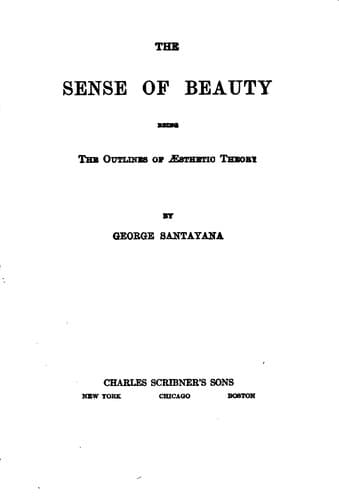
The Sense of Beauty: Being the Outlines of Aesthetic TheorySantayana, George
Philosophy
The Sense of Beauty: Being the Outlines of Aesthetic Theory
Santayana, George
Aesthetics
We are accustomed to think of prudence as estranging us only
from low and ignoble things; we forget that utility and the need of
system in our lives is a bar also to the free flights of the spirit. The
highest instincts tend to disorganization as much as the lowest,
since order and benefit is what practical morality everywhere
insists upon, while sanctity and genius are as rebellious as vice.
The constant demands of the heart and the belly can allow man
only an incidental indulgence in the pleasures of the eye and the
understanding. For this reason, utility keeps close watch over
beauty, lest in her wilfulness and riot she should offend against our
practical needs and ultimate happiness. And when the conscience
is keen, this vigilance of the practical imagination over the
speculative ceases to appear as an eventual and external check. The
least suspicion of luxury, waste, impurity, or cruelty is then a
signal for alarm and insurrection. That which emits this _sapor
hoereticus_ becomes so initially horrible, that naturally no beauty
can ever be discovered in it; the senses and imagination are in that
case inhibited by the conscience.
For this reason, the doctrine that beauty is essentially nothing but
the expression of moral or practical good appeals to persons of
predominant moral sensitiveness, not only because they wish it
were the truth, but because it largely describes the experience of
their own minds, somewhat warped in this particular. It will further
be observed that the moralists are much more able to condemn
than to appreciate the effects of the arts. Their taste is delicate
without being keen, for the principle on which they judge is one
which really operates to control and extend aesthetic effects; it is a
source of expression and of certain _nuances_ of satisfaction; but it
is foreign to the stronger and more primitive aesthetic values to
which the same persons are comparatively blind.
_The authority of morals over aesthetics._
Sec. 55. The extent to which aesthetic goods should be sacrificed is,
of course, a moral question; for the function of practical reason is
to compare, combine, and harmonize all our interests, with a view
to attaining the greatest satisfactions of which our nature is capable.
We must expect, therefore, that virtue should place the same
restraint upon all our passions -- not from superstitious aversion to
any one need, but from an equal concern for them all. The
consideration to be given to our aesthetic pleasures will depend
upon their greater or less influence upon our happiness; and as this
influence varies in different ages and countries, and with different
individuals, it will be right to let aesthetic demands count for more
or for less in the organization of life.
Public-domain text, read in full here on John Shaqi.
Reviews
Reviews
No reviews yet
Be the first to share your thoughts on this work.
Elsewhere in the archive
Join the Discussion
Join the discussion
Sign in to leave a comment or review.
Sign InorCreate an account