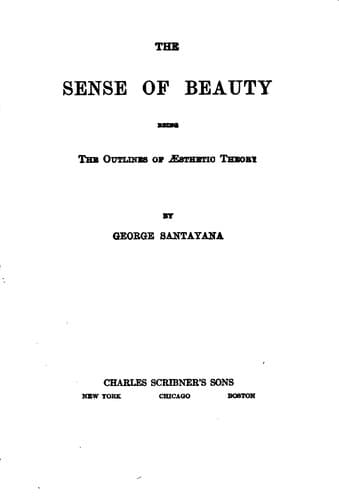
The Sense of Beauty: Being the Outlines of Aesthetic TheorySantayana, George
Philosophy
The Sense of Beauty: Being the Outlines of Aesthetic Theory
Santayana, George
Aesthetics
We may, indeed, according to our personal sympathies, prefer one
type of creature to another. We may love the martial, or the angelic,
or the political temperament. We may delight to find in others that
balance of susceptibilities and enthusiasms which we feel in our
own breast. But no moral precept can require one species or
individual to change its nature in order to resemble another, since
such a requirement can have no power or authority over those on
whom we would impose it. All that morality can require is the
inward harmony of each life: and if we still abhor the thought of a
possible being who should be happy without love, or knowledge,
or beauty, the aversion we feel is not moral but instinctive, not
rational but human. What revolts us is not the want of excellence
in that other creature, but his want of affinity to ourselves. Could
we survey the whole universe, we might indeed assign to each
species a moral dignity proportionate to its general beneficence
and inward wealth; but such an absolute standard, if it exists, is
incommunicable to us; and we are reduced to judging of the
excellence of every nature by its relation to the human.
All these matters, however, belong to the sphere of ethics, nor
should we give them here even a passing notice, but for the
influence which moral ideas exert over aesthetic judgments. Our
sense of practical benefit not only determines the moral value of
beauty, but sometimes even its existence as an aesthetic good.
Especially in the right _selection_ of effects, these considerations
have weight. Forms in themselves pleasing may become disagreeable
when the practical interests then uppermost in the mind
cannot, without violence, yield a place to them. Thus too
much eloquence in a diplomatic document, or in a familiar letter,
or in a prayer, is an offence not only against practical sense, but
also against taste. The occasion has tuned us to a certain key of
sentiment, and deprived us of the power to respond to other stimuli.
Public-domain text, read in full here on John Shaqi.
Reviews
Reviews
No reviews yet
Be the first to share your thoughts on this work.
Elsewhere in the archive
Join the Discussion
Join the discussion
Sign in to leave a comment or review.
Sign InorCreate an account