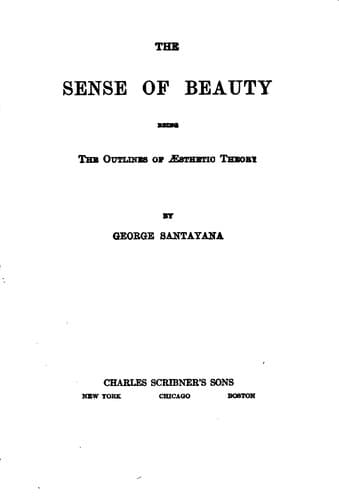
The Sense of Beauty: Being the Outlines of Aesthetic TheorySantayana, George
Philosophy
The Sense of Beauty: Being the Outlines of Aesthetic Theory
Santayana, George
Aesthetics
Sec. 56. All subjects, even the most repellent, when the
circumstances of life thrust them before us, can thus be observed
with curiosity and treated with art. The calling forth of these
aesthetic functions softens the violence of our sympathetic reaction.
If death, for instance, did not exist and did not thrust itself upon
our thoughts with painful importunity, art would never have been
called upon to soften and dignify it, by presenting it in beautiful
forms and surrounding it with consoling associations. Art does not
seek out the pathetic, the tragic, and the absurd; it is life that has
imposed them upon our attention, and enlisted art in their service,
to make the contemplation of them, since it is inevitable, at least as
tolerable as possible.
The agreeableness of the presentation is thus mixed with the horror
of the thing; and the result is that while we are saddened by the
truth we are delighted by the vehicle that conveys it to us. The
mixture of these emotions constitutes the peculiar flavour and
poignancy of pathos. But because unlovely objects and feelings are
often so familiar as to be indifferent or so momentous as to be
alone in the mind, we are led into the confusion of supposing that
beauty depends upon them for its aesthetic value; whereas the truth
is that only by the addition of positive beauties can these evil
experiences be made agreeable to contemplation.
There is, in reality, no such paradox in the tragic, comic, and
sublime, as has been sometimes supposed. We are not pleased by
virtue of the suggested evils, but in spite of them; and if ever the
charm of the beautiful presentation sinks so low, or the vividness
of the represented evil rises so high, that the balance is in favour of
pain, at that very moment the whole object becomes horrible,
passes out of the domain of art, and can be justified only by its
scientific or moral uses. As an aesthetic value it is destroyed; it
ceases to be a benefit; and the author of it, if he were not made
harmless by the neglect that must soon overtake him, would have
to be punished as a malefactor who adds to the burden of mortal
life. For the sad, the ridiculous, the grotesque, and the terrible,
unless they become aesthetic goods, remain moral evils.
Public-domain text, read in full here on John Shaqi.
Reviews
Reviews
No reviews yet
Be the first to share your thoughts on this work.
Elsewhere in the archive
Join the Discussion
Join the discussion
Sign in to leave a comment or review.
Sign InorCreate an account