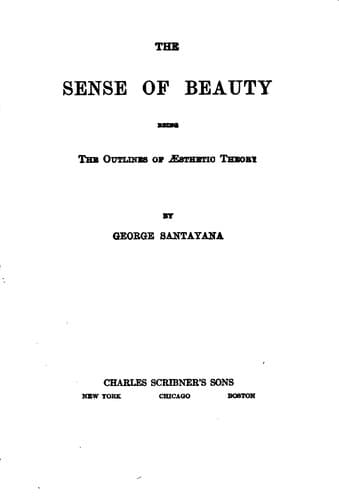
The Sense of Beauty: Being the Outlines of Aesthetic TheorySantayana, George
Philosophy
The Sense of Beauty: Being the Outlines of Aesthetic Theory
Santayana, George
Aesthetics
We have, therefore, to study the various aesthetic, intellectual, and
moral compensations by which the mind can be brought to
contemplate with pleasure a thing which, if experienced alone,
would be the cause of pain. There is, to be sure, a way of avoiding
this inquiry. We might assert that since all moderate excitement is
pleasant, there is nothing strange in the fact that the representation
of evil should please; for the experience is evil by virtue of the
pain it gives; but it gives pain only when felt with great intensity.
Observed from afar, it is a pleasing impression; it is vivid enough
to interest, but not acute enough to wound. This simple explanation
is possible in all those cases where aesthetic effect is gained by the
inhibition of sympathy.
The term "evil" is often a conventional epithet; a conflagration
may be called an evil, because it usually involves loss and
suffering; but if, without caring for a loss and suffering we do not
share, we are delighted by the blaze, and still say that what pleases
us is an evil, we are using this word as a conventional appellation,
not as the mark of a felt value. We are not pleased by an evil; we
are pleased by a vivid and exciting sensation, which is a good, but
which has for objective cause an event which may indeed be an
evil to others, but about the consequences of which we are not
thinking at all. There is, in this sense, nothing in all nature, perhaps,
which is not an evil; nothing which is not unfavourable to some
interest, and does not involve some infinitesimal or ultimate
suffering in the universe of life.
But when we are ignorant or thoughtless, this suffering is to us as
if it did not exist. The pleasures of drinking and walking are not
tragic to us, because we may be poisoning some bacillus or
crushing some worm. To an omniscient intelligence such acts may
be tragic by virtue of the insight into their relations to conflicting
impulses; but unless these impulses are present to the same mind,
there is no consciousness of tragedy. The child that, without
understanding of the calamity, should watch a shipwreck from the
shore, would hare a simple emotion of pleasure as from a jumping
jack; what passes for tragic interest is often nothing but this. If he
understood the event, but was entirely without sympathy, he would
have the aesthetic emotion of the careless tyrant, to whom the
notion of suffering is no hindrance to the enjoyment of the lyre. If
the temper of his tyranny were purposely cruel, he might add to
that aesthetic delight the luxury of _Schadenfreude;_ but the
pathos and horror of the sight could only appeal to a man who
realized and shared the sufferings he beheld.
Public-domain text, read in full here on John Shaqi.
Reviews
Reviews
No reviews yet
Be the first to share your thoughts on this work.
Elsewhere in the archive
Join the Discussion
Join the discussion
Sign in to leave a comment or review.
Sign InorCreate an account