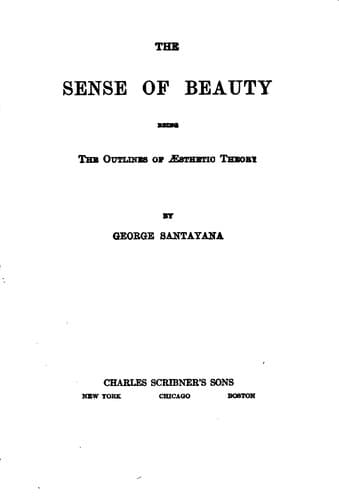
The Sense of Beauty: Being the Outlines of Aesthetic TheorySantayana, George
Philosophy
The Sense of Beauty: Being the Outlines of Aesthetic Theory
Santayana, George
Aesthetics
The counterpart of this maxim is equally true. There is no noble
sorrow except in a noble mind, because what is noble is the
reaction upon the sorrow, the attitude of the man in its presence,
the language in which he clothes it, the associations with which he
surrounds it, and the fine affections and impulses which shine
through it. Only by suffusing some sinister experience with this
moral light, as a poet may do who carries that light within him, can
we raise misfortune into tragedy and make it better for us to
remember our lives than to forget them.
There are times, although rare, when men are noble in the very
moment of passion: when that passion is not unqualified, but
already mastered by reflection and levelled with truth. Then the
experience is itself the tragedy, and no poet is needed to make it
beautiful in representation, since the sufferer has been an artist
himself, and has moulded what he has endured. But usually these
two stages have to be successive: first we suffer, afterwards we
sing. An interval is necessary to make feeling presentable, and
subjugate it to that form in which alone it is beautiful.
This form appeals to us in itself, and without its aid no
subject-matter could become an aesthetic object. The more terrible the
experience described, the more powerful must the art be which is
to transform it. For this reason prose and literalness are more
tolerable in comedy than in tragedy; any violent passion, any
overwhelming pain, if it is not to make us think of a demonstration
in pathology, and bring back the smell of ether, must be rendered
in the most exalted style. Metre, rhyme, melody, the widest nights
of allusion, the highest reaches of fancy, are there in place. For
these enable the mind swept by the deepest cosmic harmonies, to
endure and absorb the shrill notes which would be intolerable in a
poorer setting.
The sensuous harmony of words, and still more the effects of
rhythm, are indispensable at this height of emotion. Evolutionists
have said that violent emotion naturally expresses itself in rhythm.
That is hardly an empirical observation, nor can the expressiveness
of rhythms be made definite enough to bear specific association
with complex feelings. But the suspension and rush of sound and
movement have in themselves a strong effect; we cannot undergo
them without profound excitement; and this, like martial music,
nerves us to courage and, by a sort of intoxication, bears us along
amid scenes which might otherwise be sickening. The vile effect of
literal and disjointed renderings of suffering, whether in writing or
acting, proves how necessary is the musical quality to tragedy -- a
fact Aristotle long ago set forth. The afflatus of rhythm, even if it
be the pomp of the Alexandrine, sublimates the passion, and
clarifies its mutterings into poetry. This breadth and rationality are
necessary to art, which is not skill merely, but skill in the service
of beauty.
Public-domain text, read in full here on John Shaqi.
Reviews
Reviews
No reviews yet
Be the first to share your thoughts on this work.
Elsewhere in the archive
Join the Discussion
Join the discussion
Sign in to leave a comment or review.
Sign InorCreate an account