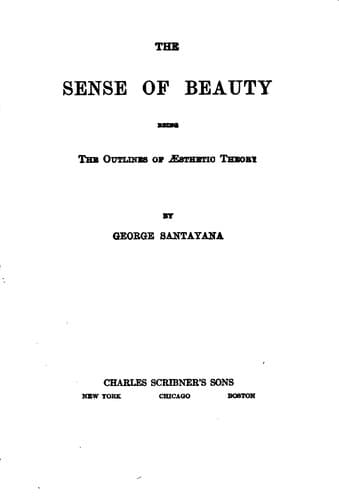
The Sense of Beauty: Being the Outlines of Aesthetic TheorySantayana, George
Philosophy
The Sense of Beauty: Being the Outlines of Aesthetic Theory
Santayana, George
Aesthetics
A great deal of brutal tragedy has been endured in the world
because the rudeness of the representation, or of the public, or of
both, did not allow a really sympathetic reaction to arise. We all
smile when Punch beats Judy in the puppet show. The treatment
and not the subject is what makes a tragedy. A parody of _Hamlet_
or of _King Lear_ would not be a tragedy; and these tragedies
themselves are not wholly such, but by the strain of wit and
nonsense they contain are, as it were, occasional parodies on
themselves. By treating a tragic subject bombastically or satirically
we can turn it into an amusement for the public; they will not feel
the griefs which we have been careful to harden them against by
arousing in them contrary emotions. A work, nominally a work of
art, may also appeal to non-aesthetic feelings by its political bias,
brutality, or obscenity. But if an effect of true pathos is sought, the
sympathy of the observer must be aroused; we must awaken in him
the emotion we describe. The intensity of the impression must not
be so slight that its painful quality is not felt; for it is this very
sense of pain, mingling with the aesthetic excitement of the
spectacle, that gives it a tragic or pathetic colouring.
We cannot therefore rest in the assertion that the slighter degree of
excitement is pleasant, when a greater degree of the same would be
disagreeable; for that principle does not express the essence of the
matter, which is that we must be aware of the evil, and conscious
of it as such, absorbed more or less in the experience of the
sufferer, and consequently suffering ourselves, before we can
experience the essence of tragic emotion. This emotion must
therefore be complex; it must contain an element of pain
overbalanced by an element of pleasure; in our delight there must
be a distinguishable touch of shrinking and sorrow; for it is this
conflict and rending of our will, this fascination by what is
intrinsically terrible or sad, that gives these turbid feelings their
depth and pungency.
_Influence of the first term in the pleasing expression of self._
Sec. 57. A striking proof of the compound nature of tragic effects can
be given by a simple experiment. Remove from any drama -- say
from _Othello_ -- the charm of the medium of presentation; reduce
the tragedy to a mere account of the facts and of the words spoken,
such as our newspapers almost daily contain; and the tragic dignity
and beauty is entirely lost. Nothing remains but a disheartening
item of human folly, which may still excite curiosity, but which
will rather defile than purify the mind that considers it. A French
poet has said:
Il n'est de vulgaire chagrin
Qua celui d'une ame vulgaire.
Public-domain text, read in full here on John Shaqi.
Reviews
Reviews
No reviews yet
Be the first to share your thoughts on this work.
Elsewhere in the archive
Join the Discussion
Join the discussion
Sign in to leave a comment or review.
Sign InorCreate an account