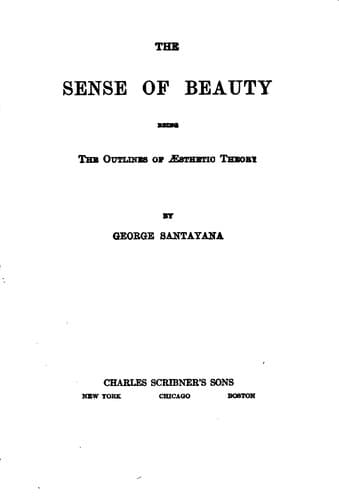
The Sense of Beauty: Being the Outlines of Aesthetic TheorySantayana, George
Philosophy
The Sense of Beauty: Being the Outlines of Aesthetic Theory
Santayana, George
Aesthetics
Obedience to God is for the Christian, as conformity to the laws of
nature or reason is for the Stoic, an attitude which has a certain
emotional and passionate worth, apart from its original justification
by maxims of utility. This emotional and passionate force is the
essence of fanaticism, it makes imperatives categorical, and gives
them absolute sway over the conscience in spite of their
one-sidedness and their injustice to the manifold demands of human
nature.
Obedience to God or reason can originally recommend itself to a
man only as the surest and ultimately least painful way of
balancing his aims and synthesizing his desires. So necessary is
this sanction even to the most impetuous natures, that no martyr
would go to the stake if he did not believe that the powers of nature,
in the day of judgment, would be on his side. But the human mind
is a turbulent commonwealth, and the laws that make for the
greatest good cannot be established in it without some partial
sacrifice, without the suppression of many particular impulses.
Hence the voice of reason or the command of God, which makes
for the maximum ultimate satisfaction, finds itself opposed by
sundry scattered and refractory forces, which are henceforth
denominated bad. The unreflective conscience, forgetting the
vicarious source of its own excellence, then assumes a solemn and
incomprehensible immediacy, as if its decrees were absolute and
intrinsically authoritative, not of to-day or yesterday, and no one
could tell whence they had arisen. Instinct can all the more easily
produce this mystification when it calls forth an imaginative
activity full of interest and eager passion. This effect is
conspicuous in the absolutist conscience, both devotional and
rationalistic, as also in the passion of love. For in all these a certain
individuality, definiteness, and exclusiveness is given to the
pursued object which is very favourable to zeal, and the heat of
passion melts together the various processes of volition into the
consciousness of one adorable influence.
However deceptive these complications may prove to men of
action and eloquence, they ought not to impose on the critic of
human nature. Evidently what value general goods do not derive
from the particular satisfactions they stand for, they possess in
themselves as ideas pleasing and powerful over the imagination.
This intrinsic advantage of certain principles and methods is none
the less real for being in a sense aesthetic. Only a sordid
utilitarianism that subtracts the imagination from human nature, or
at least slurs over its immense contribution to our happiness, could
fail to give these principles the preference over others practically
as good.
Public-domain text, read in full here on John Shaqi.
Reviews
Reviews
No reviews yet
Be the first to share your thoughts on this work.
Join the Discussion
Join the discussion
Sign in to leave a comment or review.
Sign InorCreate an account