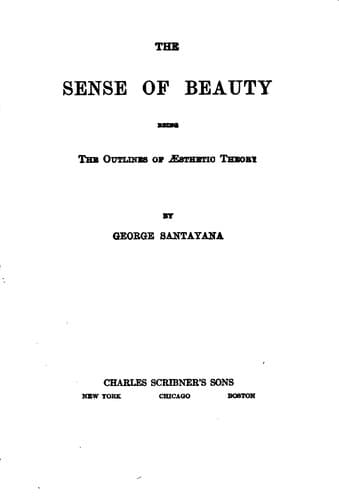
The Sense of Beauty: Being the Outlines of Aesthetic Theory — John Shaqi
The Sense of Beauty: Being the Outlines of Aesthetic TheorySantayana, George
Philosophy
The Sense of Beauty: Being the Outlines of Aesthetic Theory
Santayana, George
Aesthetics
There is no function of our nature which cannot contribute
something to this effect, but one function differs very much from
another in the amount and directness of its contribution. The
pleasures of the eye and ear, of the imagination and memory, are
the most easily objectified and merged in ideas; but it would betray
inexcusable haste and slight appreciation of the principle involved,
if we called them the only materials of beauty. Our effort will
rather be to discover its other sources, which have been more
generally ignored, and point out their importance. For the five
senses and the three powers of the soul, which play so large a part
in traditional psychology, are by no means the only sources or
factors of consciousness; they are more or less external divisions of
its content, and not even exhaustive of that. The nature and
changes of our life have deeper roots, and are controlled by less
obvious processes.
The human body is a machine that holds together by virtue of
certain vital functions, on the cessation of which it is dissolved.
Some of these, like the circulation of the blood, the growth and
decay of the tissues, are at first sight unconscious. Yet any
important disturbance of these fundamental processes at once
produces great and painful changes in consciousness. Slight
alterations are not without their conscious echo: and the whole
temper and tone of our mind, the strength of our passions, the grip
and concatenation of our habits, our power of attention, and the
liveliness of our fancy and affections are due to the influence of
these vital forces. They do not, perhaps, constitute the whole basis
of any one idea or emotion: but they are the conditions of the
existence and character of all.
Particularly important are they for the _value_ of our experience.
They constitute health, without which no pleasure can be pure.
They determine our impulses in leisure, and furnish that surplus
energy which we spend in play, in art, and in speculation. The
attraction of these pursuits, and the very existence of an aesthetic
sphere, is due to the efficiency and perfection of our vital processes.
The pleasures which they involve are not exclusively bound to any
particular object, and therefore do not account for the relative
beauty of things. They are loose and unlocalized, having no special
organ, or one which is internal and hidden within the body. They
therefore remain undiscriminated in consciousness, and can serve
to add interest to any object, or to cast a general glamour over the
world, very favourable to its interest and beauty.
Public-domain text, read in full here on John Shaqi.
Reviews
Reviews
No reviews yet
Be the first to share your thoughts on this work.
Join the Discussion
Join the discussion
Sign in to leave a comment or review.
Sign InorCreate an account