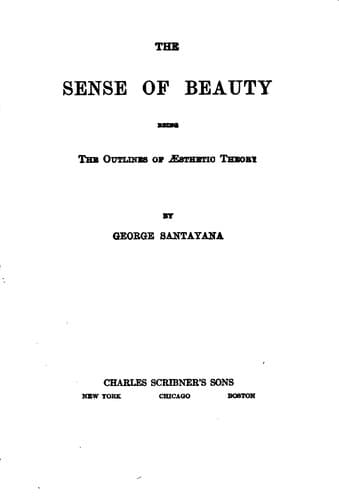
The Sense of Beauty: Being the Outlines of Aesthetic TheorySantayana, George
Philosophy
The Sense of Beauty: Being the Outlines of Aesthetic Theory
Santayana, George
Aesthetics
The intellectual suggestion of the infinity of nature can, moreover,
be awakened by other experiences which are by no means sublime.
A heap of sand will involve infinity as surely as a universe of suns
and planets. Any object is infinitely divisible and, when we press
the thought, can contain as many worlds with as many winged
monsters and ideal republics as can the satellites of Sirius. But the
infinitesimal does not move us aesthetically; it can only awaken an
amused curiosity. The difference cannot lie in the import of the
idea, which is objectively the same in both cases. It lies in the
different immediate effect of the crude images which give us the
type and meaning of each; the crude image that underlies the idea
of the infinitesimal is the dot, the poorest and most uninteresting of
impressions; while the crude image that underlies the idea of
infinity is space, multiplicity in uniformity, and this, as we have
seen, has a powerful effect on account of the breadth, volume, and
omnipresence of the stimulation. Every point in the retina is evenly
excited, and the local signs of all are simultaneously felt. This
equable tension, this balance and elasticity in the very absence of
fixity, give the vague but powerful feeling that we wish to describe.
Did not the infinite, by this initial assault upon our senses, awe us
and overwhelm us, as solemn music might, the idea of it would be
abstract and moral like that of the infinitesimal, and nothing but an
amusing curiosity.
Nothing is objectively impressive; things are impressive only when
they succeed in touching the sensibility of the observer, by finding
the avenues to his brain and heart. The idea that the universe is a
multitude of minute spheres circling, like specks of dust, in a dark
and boundless void, might leave us cold and indifferent, if not
bored and depressed, were it not that we identify this hypothetical
scheme with the visible splendour, the poignant intensity, and the
baffling number of the stars. So far is the object from giving value
to the impression, that it is here, as it must always ultimately be,
the impression that gives value to the object. For all worth leads us
back to actual feeling somewhere, or else evaporates into nothing
-- into a word and a superstition.
Public-domain text, read in full here on John Shaqi.
Reviews
Reviews
No reviews yet
Be the first to share your thoughts on this work.
Elsewhere in the archive
Join the Discussion
Join the discussion
Sign in to leave a comment or review.
Sign InorCreate an account