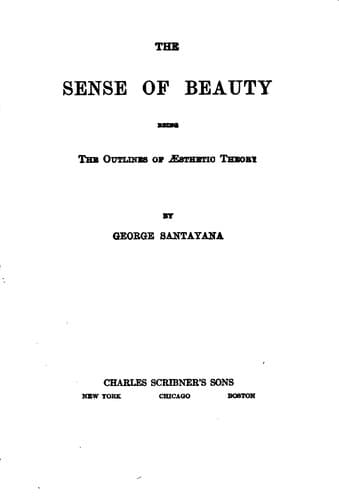
The Sense of Beauty: Being the Outlines of Aesthetic TheorySantayana, George
Philosophy
The Sense of Beauty: Being the Outlines of Aesthetic Theory
Santayana, George
Aesthetics
Now these various perfections are mutually exclusive. Only in a
kind of aesthetic orgy -- in the madness of an intoxicated
imagination -- can we confuse them. As the Roman emperor
wished that the Roman people had but a single neck, to murder
them at one blow, so we may sometimes wish that all beauties had
but one form, that we might behold them together. But in the
nature of things beauties are incompatible. The spring cannot
coexist with the autumn, nor day with night; what is beautiful in a
child is hideous in a man, and _vice versa;_ every age,
every country, each sex, has a peculiar beauty, finite and
incommunicable; the better it is attained the more completely it
excludes every other. The same is evidently true of schools of art,
of styles and languages, and of every effect whatsoever. It exists
by its finitude and is great in proportion to its determination.
But there is a loose and somewhat helpless state of mind in which
while we are incapable of realizing any particular thought or vision
in its perfect clearness and absolute beauty, we nevertheless feel its
haunting presence in the background of consciousness. And one
reason why the idea cannot emerge from that obscurity is that it is
not alone in the brain; a thousand other ideals, a thousand other
plastic tendencies of thought, simmer there in confusion; and if any
definite image is presented in response to that vague agitation of
our soul, we feel its inadequacy to our need in spite of, or perhaps
on account of, its own particular perfection. We then say that the
classic does not satisfy us, and that the "Grecian cloys us with his
perfectness." We are not capable of that concentrated and serious
attention to one thing at a time which would enable us to sink into
its being, and enjoy the intrinsic harmonies of its form, and the
bliss of its immanent particular heaven; we flounder in the vague,
but at the same time we are full of yearnings, of half-thoughts and
semi-visions, and the upward tendency and exaltation of our mood
is emphatic and overpowering in proportion to our incapacity to
think, speak, or imagine.
The sum of our incoherences has, however, an imposing volume
and even, perhaps, a vague, general direction. We feel ourselves
laden with an infinite burden; and what delights us most and seems
to us to come nearest to the ideal is not what embodies any one
possible form, but that which, by embodying none, suggests many,
and stirs the mass of our inarticulate imagination with a pervasive
thrill. Each thing, without being a beauty in itself, by stimulating
our indeterminate emotion, seems to be a hint and expression of
infinite beauty. That infinite perfection which cannot be realized,
because it is self-contradictory, may be thus suggested, and on
account of this suggestion an indeterminate effect may be regarded
as higher, more significant, and more beautiful than any
determinate one.
Public-domain text, read in full here on John Shaqi.
Reviews
Reviews
No reviews yet
Be the first to share your thoughts on this work.
Elsewhere in the archive
Join the Discussion
Join the discussion
Sign in to leave a comment or review.
Sign InorCreate an account