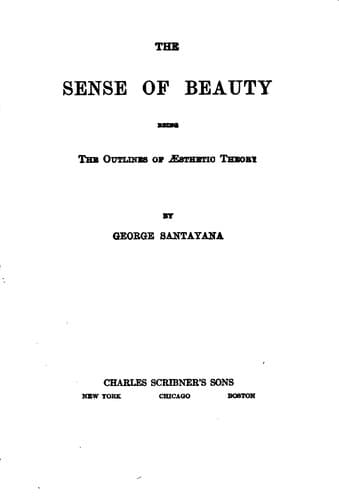
The Sense of Beauty: Being the Outlines of Aesthetic TheorySantayana, George
Philosophy
The Sense of Beauty: Being the Outlines of Aesthetic Theory
Santayana, George
Aesthetics
The illusion, however, is obvious. The infinite perfection
suggested is an absurdity. What exists is a vague emotion, the
objects of which, if they could emerge from the chaos of a
confused imagination, would turn out to be a multitude of
differently beautiful determinate things. This emotion of infinite
perfection is the _materia prima -- rudis indigestaque moles --_ out
of which attention, inspiration, and art can bring forth an infinity of
particular perfections. Every aesthetic success, whether in
contemplation or production, is the birth of one of these
possibilities with which the sense of infinite perfection is pregnant.
A work of art or an act of observation which remains indeterminate
is, therefore, a failure, however much it may stir our emotion. It is
a failure for two reasons. In the first place this emotion is seldom
wholly pleasant; it is disquieting and perplexing; it brings a desire
rather than a satisfaction. And in the second place, the emotion, not
being embodied, fails to constitute the beauty of anything; and
what we have is merely a sentiment, a consciousness that values
are or might be there, but a failure to extricate those values, or to
make them explicit and recognizable in an appropriate object.
These gropings after beauty have their worth as signs of aesthetic
vitality and intimations of future possible accomplishment; but in
themselves they are abortive, and mark the impotence of the
imagination. Sentimentalism in the observer and romanticism in
the artist are examples of this aesthetic incapacity. Whenever
beauty is really seen and loved, it has a definite embodiment: the
eye has precision, the work has style, and the object has perfection.
The kind of perfection may indeed be new; and if the discovery of
new perfections is to be called romanticism, then romanticism is
the beginning of all aesthetic life. But if by romanticism we mean
indulgence in confused suggestion and in the exhibition of turgid
force, then there is evidently need of education, of attentive labour,
to disentangle the beauties so vaguely felt, and give each its
adequate embodiment. The breadth of our inspiration need not be
lost in this process of clarification, for there is no limit to the
number and variety of forms which the world may be made to wear;
only, if it is to be appreciated as beautiful and not merely felt as
unutterable, it must be seen as a kingdom of forms. Thus the works
of Shakespeare give us a great variety, with a frequent marvellous
precision of characterization, and the forms of his art are definite
although its scope is great.
Public-domain text, read in full here on John Shaqi.
Reviews
Reviews
No reviews yet
Be the first to share your thoughts on this work.
Elsewhere in the archive
Join the Discussion
Join the discussion
Sign in to leave a comment or review.
Sign InorCreate an account