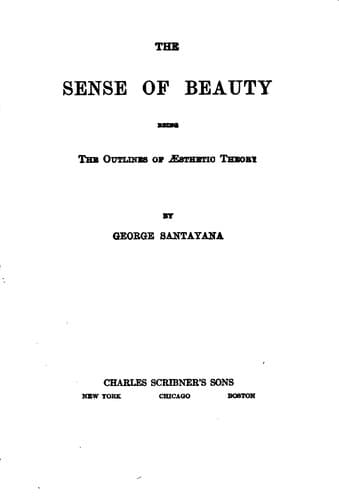
The Sense of Beauty: Being the Outlines of Aesthetic TheorySantayana, George
Philosophy
The Sense of Beauty: Being the Outlines of Aesthetic Theory
Santayana, George
Aesthetics
But by a curious anomaly, we are often expected to see the greatest
expressiveness in what remains indeterminate, and in reality
expresses nothing. As we have already observed, the sense of
profundity and significance is a very detachable emotion; it can
accompany a confused jumble of promptings quite as easily as it
can a thorough comprehension of reality. The illusion of infinite
perfection is peculiarly apt to produce this sensation. That illusion
arises by the simultaneous awakening of many incipient thoughts
and dim ideas; it stirs the depths of the mind as a wind stirs the
thickets of a forest; and the unusual consciousness of the life and
longing of the soul, brought by that gust of feeling, makes us
recognize in the object a singular power, a mysterious meaning.
But the feeling of significance signifies little. All we have in this
case is a potentiality of imagination; and only when this
potentiality begins to be realized in definite ideas, does a real
meaning, or any object which that meaning can mean, arise in the
mind. The highest aesthetic good is not that vague potentiality, nor
that contradictory, infinite perfection so strongly desired; it is the
greatest number and variety of finite perfections. To learn to see in
nature and to enshrine in the arts the typical forms of things; to
study and recognize their variations; to domesticate the
imagination in the world, so that everywhere beauty can be seen,
and a hint found for artistic creation, -- that is the goal of
contemplation. Progress lies in the direction of discrimination and
precision, not in that of formless emotion and reverie.
_Organized nature the source of apperceptive forms; example of
sculpture._
Sec. 37. The form of the material world is in one sense always
perfectly definite, since the particles that compose it are at each
moment in a given relative position; but a world that had no other
form than that of such a constellation of atoms would remain
chaotic to our perception, because we should not be able to survey
it as a whole, or to keep our attention suspended evenly over its
innumerable parts. According to evolutionary theory, mechanical
necessity has, however, brought about a distribution and
aggregation of elements such as, for our purposes, constitutes
individual things. Certain systems of atoms move together as units;
and these organisms reproduce themselves and recur so often in
our environment, that our senses become accustomed to view their
parts together. Their form becomes a natural and recognizable one.
An order and sequence is established in our imagination by virtue
of the order and sequence in which the corresponding impressions
have come to our senses. We can remember, reproduce, and in
reproducing vary, by kaleidoscopic tricks of the fancy, the forms in
which our perceptions have come.
Public-domain text, read in full here on John Shaqi.
Reviews
Reviews
No reviews yet
Be the first to share your thoughts on this work.
Elsewhere in the archive
Join the Discussion
Join the discussion
Sign in to leave a comment or review.
Sign InorCreate an account