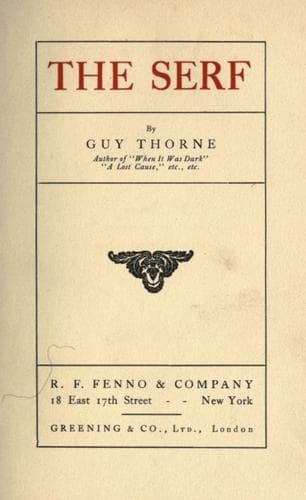
Great Britain -- History -- Stephen, 1135-1154 -- Fiction; Murder -- Fiction; Revenge -- Fiction; Serfs -- Fiction
He saw that it was his duty to kill Geoffroi for the sake of the others,
and, come what might, he said to himself that he would do this thing.
The clumsy medium of the printed page has allowed us to follow Hyla's
thoughts very slowly. Even as his resolve was taken, he heard Cerdic
muttering that it was "ill to fumble with Satan's tail."
"I'll do it," he said, "and it's not the Divell that will be glad,
Cerdic. No, it's not the Divell," he repeated, a little at a loss what
further to say.
Cerdic pulled from his tunic a little cross of wood, and held it out to
him. The passer-by would have seen two serfs, ill-clothed, unwashed,
uncouth, eating bread and cheese under a wall. He would never have put a
thought to them. Yet the conference of the two was fraught with
tremendous meaning to those times. For a hundred years Hyla was
remembered, and a star in the darkness to the weary; and after his name
was forgotten, the influence of his deeds made life sweeter for many
generations of the poor.
Hyla took the little cross, so that he might swear faith. With a
lingering memory of the form in which men swore oath of fealty to their
lords, he said, "I become true man to this deed from this day forward,
of life and limb and earthly service, and unto it shall be true and
faithful, and bear to you faith, Cerdic, for the aid I claim to hold of
you."
He did this in seriousness, beyond all opinion; but the importance of
the occasion, and the drama of it, pleased him not a little. The new toy
of words was pleasant.
Cerdic kissed him, entering into the spirit of the oath, for it was the
custom to kiss a man sworn to service.
"And I also am with you to the end," said Cerdic, "and may all false
ribalds die who use poor men so."
In a high voice which shook with hate he quavered out a verse of the
"Song of the Husbandman," a popular political song of those days; a
ballad which the common people sang under their breath:
"Ne mai us nyse no rest rycheis ne ro.
Thus me pileth the pore that is of lute pris:
Nede in swot and in swynk swynde mot swo."
It was the poor fellow's Marseillaise!
"_There may not arise to us, or remain with us, riches or rest. Thus
they rob the poor man, who is of little value: he must waste away in
sweat and labour._"
Doggerel, but how bitter! A sign of the times which Geoffroi could not
hear--ominous, threatening.
"A right good song, Cerdic," said Hyla. "But it will not be ever so. I
know not if we shall see it, but all things change and change shall
come from us. A tree stands not for ever."
The two men gazed steadfastly into each other's eyes, and then went
about their work in silence.
* * * * *
The drama of this history may now be said to have begun. The lamps are
trimmed, the scene set, and you shall hear the stirring story of Hyla
the Serf.
CHAPTER III
The last night of Geoffroi de la Bourne
Public-domain text, read in full here on John Shaqi.
Reviews
Reviews
No reviews yet
Be the first to share your thoughts on this work.
Join the Discussion
Join the discussion
Sign in to leave a comment or review.
Sign InorCreate an account