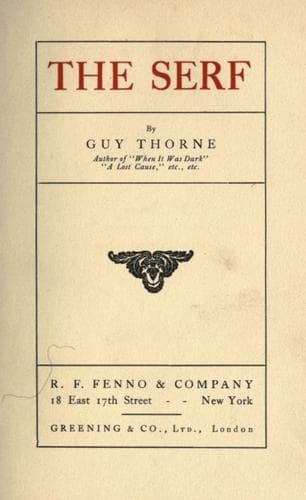
Great Britain -- History -- Stephen, 1135-1154 -- Fiction; Murder -- Fiction; Revenge -- Fiction; Serfs -- Fiction
There was something very stately in the view from the river, all
irradiated as it was by the ruddy evening light.
Hyla's punt glided over the still waters till it reached a well-built
landing-stage of stone steps descending into the river. Several punts
and boats were tied up to mooring stakes. Hard by, the sewage from the
castle was carried down by a little brook, and the air all about the
landing-place was stagnant and foul.
He moored the punt, and, stringing his eels upon an iron hook, carried
them up the hill in the waning light. The very last lights of the day
were now expiring, and the scene was full of peace and rest, as night
threw her cloak over the world. A rabbit ran across Hyla's path from
side to side of the road, a dusky flash; and, high up in the air, a bird
suddenly began to trill the night a welcome.
The man walked slowly, lurching along with his head bent down, and
seeing nothing of the evening time. About half-way up the hill he heard
someone whistling a comic song, with which a wandering minstrel had
convulsed the inmates of the castle a night or two before.
Sitting by the roadside in the dusk, he could distinguish the figure of
Pierce, one of the men-at-arms. He was oiling the trigger and barrel of
a crossbow, and polishing the steel parts with a soft skin. The
man-at-arms lived in the village with his wife, and was practically in
the position of a villein, holding some fields from Lord Geoffroi in
return for military service. He was from Boulogne, and had been in the
garrison of one of Robert de Bellême's castles in Normandy.
The lessons learnt at Tenchebrai had sunk deep into the mind of this
fellow; and when any dirty work was afoot or any foul deed to be done,
to Pierce was given the doing of it. As Hyla approached, he stopped his
whistling, and broke out into the words of the song, which, filthy and
obscene as it was, had enormous popularity all over the countryside.
Then he noticed the serf's approach. "Who are you?" he called out in a
_patois_ of Norman-French and English, with the curious see-saw of
French accentuation in his voice.
"Hyla!" came the answer, and there was strength and music in it.
Something seemed to tickle the soldier to immediate merriment when he
heard the identity of the man with the eels.
Hyla knew him well. When he was free from his duties in the castle, Hyla
and his wife worked in this man's fields for a loaf of wastel bread or a
chance rabbit, and he was in a sense their immediate employer and
patron.
It was at the order of Pierce that Hyla had been fishing that evening.
The soldier chuckled on, regarding the serf with obvious amusement,
though for what reason _he_ could not imagine.
"Show your catch," he said at last.
He was shown the hook of great eels, some of which still writhed slowly
in torture.
"Take them to my wife," said the soldier, "and take what you want of
them for yourself and your people."
"Very gladly," said Hyla, "for there are many mouths to fill."
Public-domain text, read in full here on John Shaqi.
Reviews
Reviews
No reviews yet
Be the first to share your thoughts on this work.
Join the Discussion
Join the discussion
Sign in to leave a comment or review.
Sign InorCreate an account