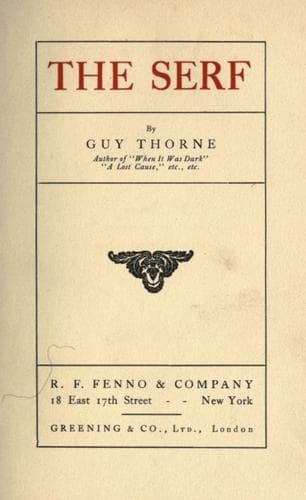
Great Britain -- History -- Stephen, 1135-1154 -- Fiction; Murder -- Fiction; Revenge -- Fiction; Serfs -- Fiction
Thin lines of lights, like jewels in velvet, began to twinkle out in the
black walls of the castle as he turned towards the place of the serfs.
He went down a lane fringed with beeches, and emerged upon the open
glade. A fire was burning in the centre, and dark forms were flitting
round it cooking the evening meals. Dogs were barking, and there was a
continual hum and clatter of life.
Picture for yourself an oblong space surrounded by heavy trees, the
outer boles being striped clear of bark, and many of them remaining but
dead stumps.
Round the arena stood forty or fifty huts of wood, wattled with oziers
and thatched with fern and dried rushes.
Many of the huts were built round a tree trunk, and the pole in the
middle served to hang skins and implements upon by means of wooden pegs
driven into it.
A hole in the roof let out smoke, and in the walls let in the light.
The floors of these huts were of hard-beaten earth, as durable as stone;
but they were littered with old bones, dust, and dried rushes for
several inches deep, and swarming with animal life.
They were the merest shelters, and served only for sleep. Most of the
household business was conducted in the open before the huts, and in
fine weather the fires were nearly all outside. In winter time the serf
women and girls generally suffered from an irritating soreness of the
eyes, which was produced by living in the acrid smoke which filled the
shelters and escaped but slowly through the roofs.
The household utensils were few and simple. A large wooden bucket, which
was carried on a pole between two women, served to fetch water from the
well upon the village green, for the serfs had no watering-place in
their own enclosure. An earthenware pot or so--very liable to break and
crack, as it was baked from the black and porous fen clay--and an iron
cooking pot, often the common property of two or more families,
comprised the household goods.
They slept in the back part of the huts, men, women, and children
together, on dried fern, or with, perhaps, an old and filthy sheep's
skin for cover. The sleeping-room was called the "bower."
This enclosure where the theows lived was known as the "fold," as it was
fenced in from the forest, on which it abutted, by felled trees. This
was done for protection against wild beasts. Herds of wild and savage
white cattle, such as may now only be seen at Chillingham, roamed
through the wood. Savage boars lived on the forest acorns, and would
attack an unarmed man at sight. Wolves abounded in the depths of the
forest. It often happened that some little serf child wandered away, and
was never seen again, and it was useless for a thrall to attempt escape
into its mysterious depths.
For the most part only married serfs lived in the fold or "stoke," as it
was sometimes called. Many of the younger men were employed as grooms
and water-carriers in the castle, or slept and lived in sheds and cattle
houses belonging to the men-at-arms and farmers in the village.
Public-domain text, read in full here on John Shaqi.
Reviews
Reviews
No reviews yet
Be the first to share your thoughts on this work.
Join the Discussion
Join the discussion
Sign in to leave a comment or review.
Sign InorCreate an account