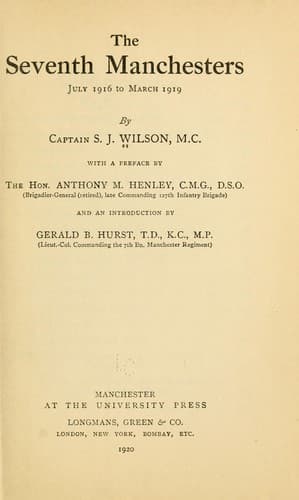
The Seventh Manchesters: July 1916 to March 1919Wilson, S. J.
History
The Seventh Manchesters: July 1916 to March 1919
Wilson, S. J.
Great Britain. Army. Manchester Regiment. Battalion, 7th (Territorial); World War, 1914-1918 -- Regimental histories -- Great Britain
The pre-arranged plan was carried out, and after the 127th brigade had
made good the high ground east of Thilloy, in face of some opposition,
the East Lancs. came through and took up the advance on what had now
become a one brigade front. They had not gone far before they
encountered the enemy in strength holding Riencourt, and they promptly
attacked it. The 8th Manchesters bore the brunt of this attack and they
suffered very heavily, little ground being gained. A brilliant night
show by the 10th the next night, however, subdued Riencourt, and this
rendered the line sufficiently straight to be able to continue the
advance. The 127th brigade took over the front again and rapid
preparations were made to co-operate in an attack which was to take
place along the whole army front. It was now clear that our higher
command were not disposed to allow the enemy to settle anywhere, if
possible. It promised to be ding-dong work amidst ever-changing scenes,
with the guns making the most of their opportunities and struggling over
the torn ground behind the infantry as best they might. But the supply
services experienced the biggest demand upon their wits and resources,
uprooted from their comfortable and secure villages and cast out upon
the shelterless land of the devastated area just like the infantry.
Their work was wonderful, however, and very rarely had Tommy occasion to
grouse about either the quality or the quantity of the food that was
served up to him under these trying conditions. It was common knowledge
that when the Boche had come over in March, he had not been so well
treated, and had been forced in the urgency of his plight to eat horses
and mules killed in the fighting.
It was evident that we had now got the full measure of our foes, and
were in the comfortable position of being able to give battle when and
where we pleased, and be practically confident of success. The front was
becoming shorter also, with the result that a divisional sector was
considerably smaller than formerly, and this entailed of course longer
periods out of the line for the soldier. Leave also continued to flow,
and proved an important factor in keeping up the morale of the troops.
How different from the old days, when we used to advertise our
intentions to the Hun when a stunt was impending by stopping leave in
the army concerned! Capt. Grey Burn, M.C., went to England for a month
on August 31st, and Lt. S. J. Wilson was put in command of "B" company
for the coming operations, while in the continued absence of Capt.
Palmer, Lt. Hammond was in charge of "C" company. Lt. Smithies, recently
joined from the second line, took over the duties of intelligence
officer. Col. Manger was required to temporarily command the 126th
brigade, and this left Major Rae in command of the battalion once more.
Public-domain text, read in full here on John Shaqi.
Reviews
Reviews
No reviews yet
Be the first to share your thoughts on this work.
Elsewhere in the archive
Join the Discussion
Join the discussion
Sign in to leave a comment or review.
Sign InorCreate an account