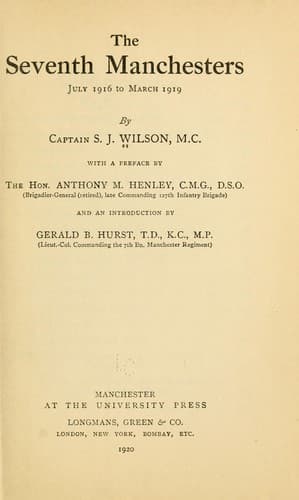
The Seventh Manchesters: July 1916 to March 1919Wilson, S. J.
History
The Seventh Manchesters: July 1916 to March 1919
Wilson, S. J.
Great Britain. Army. Manchester Regiment. Battalion, 7th (Territorial); World War, 1914-1918 -- Regimental histories -- Great Britain
The next village in our line of advance, now practically due east, was
Villers-au-Flos, and this, with the high ground beyond it, was to be
taken in the first stride of the coming battle, a matter of 2,500 yards.
After this the L.F's. would leap-frog through and exploit success as far
as possible. This time the 5th and 6th were detailed to execute the
first shock of the assault with the 7th in close support. As a matter of
fact "C" company were sent forward to act under the orders of the 5th in
view of the extra opposition which was expected on the right sector. On
the night of September 1st the remainder of the battalion, in order "B,"
"A," "D," companies moved up close to Riencourt, to occupy old, shallow
trenches, and await the needs of the brigade either during or after the
assault.
Soon after dawn the barrage opened, and simultaneously the Manchesters
advanced accompanied by a single tank. The New Zealanders were carrying
out a similar task on the left, while the 17th division had to get
through Beaulencourt and over a large stretch of bare country on the
right. The 6th Manchesters progressed in fine style, and everything went
according to plan. The enemy put up a stiff fight for it and hung on to
the last in the cunningly concealed machine gun posts. It was in this
part of the fighting that Lieut. Welch (a one-time 7th officer) with a
section of Stokes' mortar men performed a gallant deed that earned for
him the D.S.O. The progress of events on the right, however, was not so
clear and straightforward. As was expected the 5th encountered strong
opposition, for they advanced along a double row of old German trenches
which contained a large number of dug-outs, and disconcerting masses of
wire at irregular intervals. It was thus difficult to maintain cohesion
in the attack, while every dug-out contained machine gun crews who had
been unharmed by the barrage, and who, owing to the delay in getting
ahead, had been able to come out and man their positions without
interruption. The 5th, therefore, lost heavily, particularly on their
right flank, and before very long "C" company of the 7th found
themselves in the front, almost isolated, and taking a stern part in the
assault.
Public-domain text, read in full here on John Shaqi.
Reviews
Reviews
No reviews yet
Be the first to share your thoughts on this work.
Elsewhere in the archive
Join the Discussion
Join the discussion
Sign in to leave a comment or review.
Sign InorCreate an account