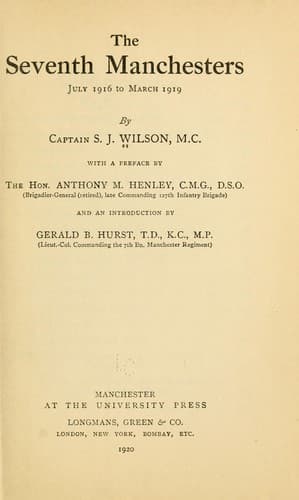
The Seventh Manchesters: July 1916 to March 1919Wilson, S. J.
History
The Seventh Manchesters: July 1916 to March 1919
Wilson, S. J.
Great Britain. Army. Manchester Regiment. Battalion, 7th (Territorial); World War, 1914-1918 -- Regimental histories -- Great Britain
With characteristic impetuosity, reminiscent of the La Signy Farm days,
Gresty and the men of "D" following up under the barrage, rushed across
the Brown Line and made for the Yellow Line. They were now only a small
gallant band but they were undaunted. Prisoners captured were told to go
down to the rear, which they did right gladly without an escort, so that
the assaulting party who now in formation and well-nigh in size, began
to resemble a Rugby football team, could preserve their strength. Two 77
m.m. guns lay in their path, and at their approach the Boche gunners
spiked them and made off, leaving them an easy prey to the 7th. After
this, Gresty decided that he was on his objective, as indeed he was, but
he was more or less in the 6th sector, and when he was quickly joined by
a company of the 6th he began to realise it. There was trouble on his
right, however, as well as from the front, and the small party of men
were disposed to defend the ground they had captured, a difficult enough
task in view of the fact that they had to find positions to face in two
or three different directions. Touch was obtained with the 62nd division
in Ribecourt, and it was found that the VIth corps had had great success
in their part of the battle, so that already the advance was proceeding
towards Marcoing.
"B" company's effort was really a separate story. As soon as "D" company
had disappeared over the crest in front of the Red Line they continued
the advance. 2nd-Lt. Pearson was on the extreme right and he had been
instructed to keep touch with the L.F's. From the beginning, however, he
had not seen them, and his platoon was moving along "in the air," and
naturally meeting with strong resistance. They had not expected to meet
the enemy for another 1,500 yards if events had worked out "according to
plan," but they were now fighting them at every step. Gallant deeds were
performed in dealing with Hun machine guns, and many prisoners were
taken, but greatest of all were the achievements of Pte. Jack White.
Single-handed he rushed a machine gun post, bayonetted the man on the
gun and pursued the remainder of the team with fire, inflicting
casualties. Later on he again rushed forward alone to a strongly held
trench, but was killed practically on the parapet. His name was
recommended for a V.C., but unfortunately nothing more was heard of it.
In view of the heavy casualties, Lt. Wilson went across to Pearson and
told him to close his platoon slightly towards the left, in order to
keep a cohesion in the company, for it was evident that the Hun
resistance promised to be strong, and there was no hope now of
assistance from the right flank. In this manner the high ground near the
Brown Line was reached, but the company was suffering from fire both
from the front and the right flank. 2nd-Lts. Siddall and Gapp were
wounded, as well as three platoon sergeants, and there was no knowledge
as to what had happened to "D" company. At this moment the Germans
Public-domain text, read in full here on John Shaqi.
Reviews
Reviews
No reviews yet
Be the first to share your thoughts on this work.
Elsewhere in the archive
Join the Discussion
Join the discussion
Sign in to leave a comment or review.
Sign InorCreate an account