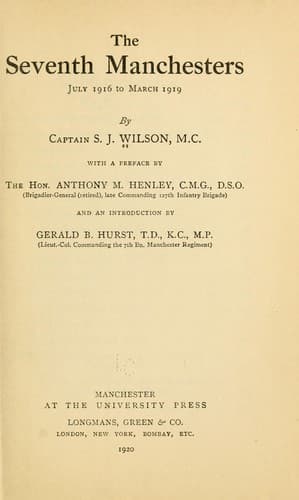
The Seventh Manchesters: July 1916 to March 1919Wilson, S. J.
History
The Seventh Manchesters: July 1916 to March 1919
Wilson, S. J.
Great Britain. Army. Manchester Regiment. Battalion, 7th (Territorial); World War, 1914-1918 -- Regimental histories -- Great Britain
developed a counter-attack from the right in a manner to be expected
from an intelligent and courageous enemy. The obvious thing for them to
do was to cut in behind "B" company's right flank and attempt to regain
a footing in "Unseen Trench" which had just been taken from them. From
an offensive force we were suddenly transformed into a defensive force,
and the men were still out in the open. Wilson drew back his right flank
so as to face the Huns, but kept his left in touch with the 6th on the
road in front of the Brown Line, and from this position, the men being
disposed in shell holes, "B" company held up the enemy attack and
defended the ground won. The Huns were on higher ground and when they
had been finally driven to earth they kept up vigorous sniping at very
close range, a form of fighting that we returned with interest. Pearson
was hit in the stomach and later died on the way down, so that Wilson
and C.S.M. Shields were left to control the remainder of the company.
The arrival of 2nd-Lt. Smith with signalling apparatus enabled
communication to be obtained with battalion H.Q. Lt. Wilson outlined
the situation and was told in return that the L.F's. had not yet reached
Boar Copse, having met with powerful resistance. He was further ordered
to hang on to his position and wait until the L.F's. had drawn up in
line. Meanwhile a company of the 5th was sent up to strengthen the
flank. Continuous touch by means of patrols were kept with the enemy,
and his movements were carefully watched. Within 300 yards were a couple
of German 77 m.m. guns, pluckily worked by the gunners at point blank
range until our machine gunners, who had now arrived, co-operated with
L.G's. from the 6th and ourselves in putting them out of action. They
were taken by the 10th in the night. Meanwhile Gresty and the company of
the 6th on the Yellow Line had been ordered to fall back 300 yards to a
less isolated position, and a sound front and flank was thus
established.
The battle had now reached a stage when the next move would be ordered
by the brigade or even by the division. Careful observation of the enemy
led us to suppose that he was weakening and Gresty and Wilson intimated
that when the L.F's. arrived at the Brown Line, having re-organised
their companies, they should be prepared to continue the advance in the
7th sector. Division had decided otherwise, however, and had ordered up
a battalion of the 126th brigade. Rapid preparations were made for a
night attack to complete the divisional task, the 10th Manchesters to
cover the 127th brigade front and the L.F's. to continue on their right.
Before nightfall, the enemy having withdrawn from the trenches
immediately in front, "B" company pushed on again and established a good
line running north and south in front of the Brown Line, and touching up
with the L.F's. who had now arrived. This considerably simplified the
work of the 10th, who were able to assemble in the night on an even
front.
Public-domain text, read in full here on John Shaqi.
Reviews
Reviews
No reviews yet
Be the first to share your thoughts on this work.
Elsewhere in the archive
Join the Discussion
Join the discussion
Sign in to leave a comment or review.
Sign InorCreate an account