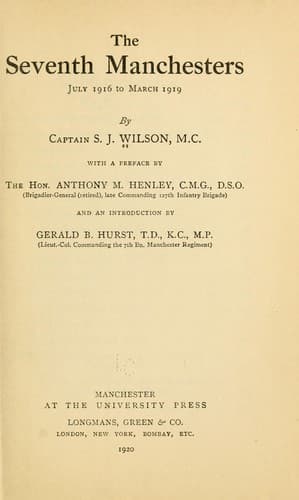
The Seventh Manchesters: July 1916 to March 1919Wilson, S. J.
History
The Seventh Manchesters: July 1916 to March 1919
Wilson, S. J.
Great Britain. Army. Manchester Regiment. Battalion, 7th (Territorial); World War, 1914-1918 -- Regimental histories -- Great Britain
The battalion marched out on the evening of November 3rd to take part in
the work of exploiting success after the N.Z. division had smashed the
enemy line. The attack commenced on the morning of November 4th, and
after fierce fighting, and only after the garrison had been completely
surrounded, Le Quesnoy was captured. The "Diggers" followed up
vigorously and chased the Huns through a large part of Mormal Forest.
Meanwhile our job was to "keep closed up" as far as possible and be
ready to continue the pursuit, with the 126th leading and the 127th in
support. The first night was spent at Viesly, and the second at Pont a
Pierre, just south of Salesches. The next day the weather completely
broke down, and we moved forward in pouring rain, over the recently
captured ground, arriving late at night in a thoroughly soaked condition
at the tiny village of Herbignies on the western edge of the Forest.
Here we found most of the civilians had remained through the fighting,
and they told excited stories of the happenings. Small children toddled
about the houses while Boche shells were still bursting not very many
hundred yards away. It seemed a most extraordinary situation after the
loneliness of war as we had always known it. These things had been the
monopoly of the soldiers, but here were women and children trespassing
upon our preserves. It helped us to realise the true tragedy of War.
That night the 126th brigade took over the front, a sketchy business in
view of the position, and the N.Z's. marched back. One of the officers,
during the day, had called out to us in characteristic Colonial fashion,
"Well, boys, are you going up to finish it?" whereupon one of the men
replied with Lancashire directness, "Ay, we started it, so we may as
well finish it." There was a good deal of peace-talk flying about.
German prisoners had admitted that they could not go on much longer,
while rumours about conferences were very prevalent. Still, until we got
orders to stop fighting, this job had to continue, and that was the
chief consideration for us, although the order to cease fire would have
been keenly appreciated.
Public-domain text, read in full here on John Shaqi.
Reviews
Reviews
No reviews yet
Be the first to share your thoughts on this work.
Elsewhere in the archive
Join the Discussion
Join the discussion
Sign in to leave a comment or review.
Sign InorCreate an account